
A fragrance can smell expensive, beautiful, and perfectly balanced on a blotter – then wear too loudly, disappear too fast, or turn unexpectedly sweet on your skin. That is why perfume oil vs eau de parfum is not just a format question. It is a performance question, especially if you care about longevity, projection, and how scent behaves on your skin over time.
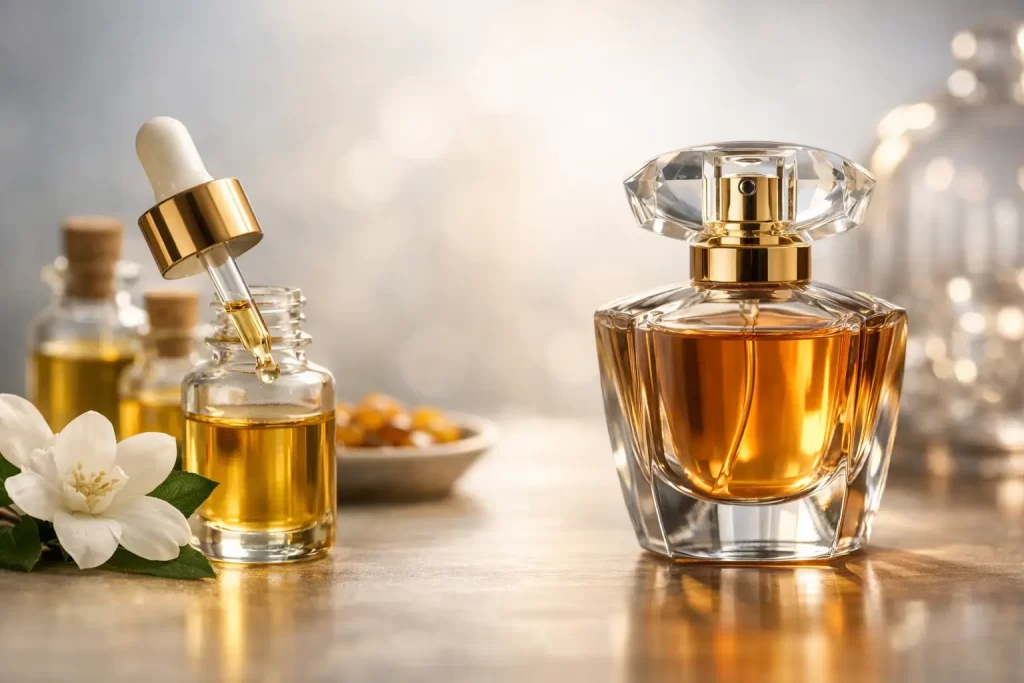
For most shoppers, the real difference is not simply oil versus alcohol. It is how each format delivers fragrance materials, how quickly it opens, how far it projects, and how closely it stays tied to your skin chemistry. If you want a scent that fills a room, an eau de parfum often has the advantage. If you want a scent that stays close and develops more softly, perfume oil may fit better.
Perfume oil vs eau de parfum: the core difference
Perfume oil is a fragrance concentrate carried in oil, usually with little to no alcohol. Eau de parfum, or EDP, is a fragrance diluted in alcohol and water, typically at a concentration high enough to deliver strong character and decent wear time without being as dense as pure parfum.
That carrier matters. Alcohol evaporates quickly, which helps an eau de parfum bloom fast and throw scent into the air. Oil evaporates much more slowly, so perfume oils tend to sit closer to the skin and reveal themselves in a quieter, more gradual way.
This is why two versions of a similar scent profile can feel very different in use. The eau de parfum may announce itself in the first 30 minutes, while the oil may feel muted at first but remain detectable on skin much later.
How they wear on skin
If your main concern is on-skin performance, the best format depends on what kind of performance you mean.
Longevity
Perfume oils often last longer on skin because the carrier evaporates slowly. That does not mean they always smell stronger for longer. It means the scent can remain present in a low-radius way for many hours, sometimes even after an eau de parfum seems to have faded.
Eau de parfum usually has strong early performance and can also last well, but its wear curve is different. You get a more noticeable opening, more lift, and often more transition from top notes to heart notes. On some skin types, especially dry skin, that lively opening can burn off faster than expected.
If your skin tends to “eat” fragrance, perfume oil can be useful because it reduces that fast evaporation effect. If you already get excellent wear from alcohol-based scents, an eau de parfum may give you the better balance of longevity and presence.
Projection and sillage
This is where eau de parfum usually pulls ahead. Because alcohol helps disperse fragrance into the air, EDPs tend to project farther and create a more obvious scent trail. If you want compliments at social distance or need a fragrance to read clearly in a large space, eau de parfum is generally the easier tool.
Perfume oils are usually more intimate. They create a skin scent effect rather than a cloud. That can be ideal for offices, travel, close-contact settings, or anyone who finds strong projection tiring. But if you expect an oil to perform like a loud evening spray, you may end up disappointed.
Development over time
Eau de parfum often gives you a more distinct fragrance journey. The top notes flash first, then the heart opens, and the base settles in. That evolution is part of the appeal.
Perfume oil can feel smoother and more compressed. Top notes may be less sparkling, and transitions can feel less dramatic. In exchange, the scent may feel richer, rounder, or warmer on skin. For resinous, woody, musky, and gourmand profiles, this can be a real advantage.
Why skin chemistry changes the answer
No format performs in a vacuum. Skin chemistry changes both perfume oil and eau de parfum, but not always in the same way.
On dry skin, eau de parfum can seem brighter at first but fade faster because there is less natural moisture to help hold the scent. Perfume oil often performs better here because the oil base adds some occlusive support. It stays anchored longer and can smell fuller.
On oilier skin, an eau de parfum may wear longer and project strongly because your natural oils help retain fragrance materials. In that case, perfume oil can still work well, but the longevity gap may be smaller than people expect.
Skin temperature also matters. Warm skin tends to amplify projection. An eau de parfum on warm skin may become much louder than intended, especially with white florals, ambers, and spicy notes. Perfume oil can control that effect by keeping the scent closer. On cooler skin, the opposite can happen: an oil may stay so close that it feels underpowered, while an eau de parfum gives the fragrance enough lift to read properly.
When perfume oil is the better choice
Perfume oil makes sense when your priority is closeness, comfort, and controlled wear. It is especially useful if you are scent-sensitive, work in a shared space, or want fragrance that feels personal rather than performative.
It also suits people who struggle with fast fade. If sprays vanish on your skin within a few hours, an oil format may give you more usable wear time. This is often true with softer scent families like musk, vanilla, sandalwood, skin scents, and certain florals.
There is another practical advantage: oils are easier to place precisely. You can apply them to pulse points or small areas without creating an oversized scent bubble. That makes them useful for touch-ups and for layering under another fragrance to increase depth without dramatically increasing projection.
When eau de parfum is the better choice
Eau de parfum is usually the better buy when you want range. It gives you a stronger opening, better air diffusion, and a more recognizable scent profile from a normal conversational distance.
If you are testing a fragrance for signature-scent potential, an EDP often reveals more of the perfumer’s intended structure. Citrus, aromatic, green, and many floral compositions benefit from that alcohol-driven lift. You smell more of the sparkle, contrast, and movement.
It is also the more flexible option for many people because application is easier to scale. One or two sprays can be restrained. Four or five can be much more present. With oils, it is harder to create that same airy aura no matter how much you apply.
Cost, value, and the blind-buy question
People often assume perfume oil is automatically a better value because it can last longer. Sometimes that is true, but value should be measured by the kind of performance you actually want.
If you want discreet all-day wear, an oil may outperform an eau de parfum for your needs even if the bottle is smaller. If you want projection, complexity, and a clear scent trail, a long-lasting oil that barely projects may still feel like poor value.
For blind buys, think about your habits first. Do you reapply during the day? Do you want your fragrance noticed by others or mainly by you? Does alcohol-based perfume disappear on your skin, or does it become too strong? The right format becomes clearer when you frame the purchase around real use rather than concentration myths.
How to test perfume oil vs eau de parfum properly
Do not compare them only from the bottle. Test each on skin, ideally on different arms, and give them several hours. The first ten minutes will favor eau de parfum because it opens faster. That is not the whole story.
Check three points in the wear cycle: the opening, the two-hour mark, and the late drydown. Notice not just whether you can smell it, but how far it travels from skin and whether the scent still feels balanced. Some oils last longer but flatten into a single note. Some EDPs project beautifully early and then vanish into a faint woody base.
Also test in the setting where you will actually wear it. A scent that feels perfect at home may behave differently in heat, cold, office air, or outdoor humidity. At PerfumeOnSkin, that real-world wear test is where format differences become much more obvious than concentration labels suggest.
Which should you choose?
Choose perfume oil if you want lower projection, better intimacy, and potentially longer close-to-skin wear, especially if your skin runs dry or sprays tend to disappear. Choose eau de parfum if you want more lift, more noticeable sillage, and a fragrance that unfolds with greater clarity from opening to drydown.
Neither is universally better. Perfume oil is not automatically stronger, and eau de parfum is not automatically longer-lasting. The better choice is the one that matches your skin, your setting, and the way you want the fragrance to be experienced.
If you are deciding between the two, start with the outcome you care about most. Not stronger on paper – better on your skin.




Leave a Comment