
You spray your usual fragrance, catch it for a minute, and then it seems to vanish. A few hours later, someone else says you smell great. That gap between what you smell and what others smell is why so many people ask: can perfume cause nose blindness? In most cases, yes – but the perfume is not damaging your nose. What you are experiencing is temporary olfactory adaptation, which means your brain starts filtering out a scent it has decided is no longer new.
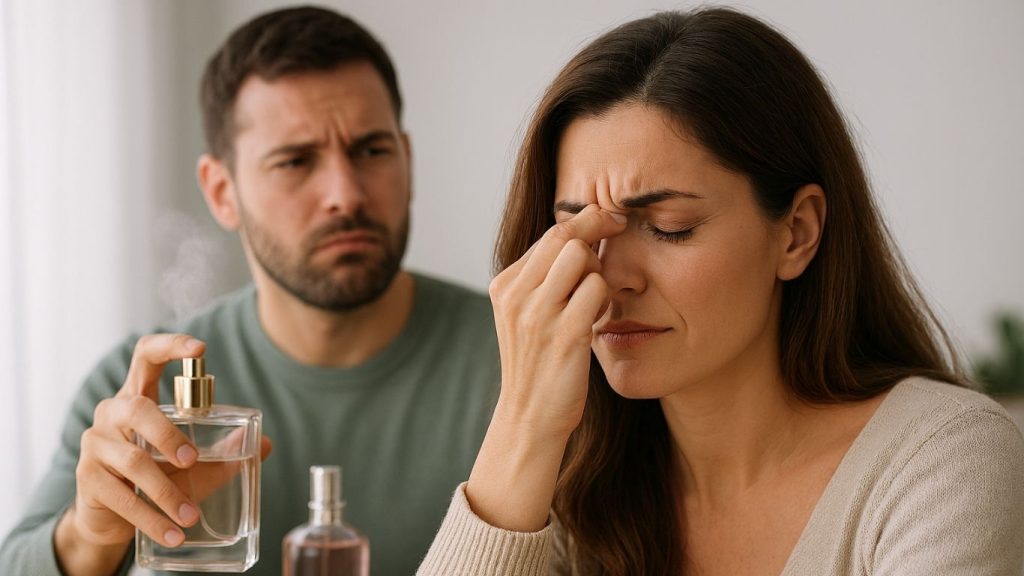
For fragrance wearers, this matters because nose blindness can lead to bad decisions. You may overspray because you think your perfume faded, or you may dismiss a fragrance as weak when it is actually projecting normally. If you want better results from the bottles you already own, understanding scent adaptation is one of the most useful performance skills you can build.
What nose blindness actually is
Nose blindness is the everyday term for olfactory fatigue or olfactory adaptation. After repeated exposure to the same smell, your sensory system becomes less responsive to it. This happens with perfume, but also with candles, laundry detergent, room fragrance, and even your own home.
The key point is that your fragrance has not necessarily disappeared from your skin. Instead, your nose and brain are reducing attention to a familiar stimulus. This is partly a filtering mechanism. If your brain treated every constant smell as urgent, it would be much harder to notice changes in your environment.
With perfume, this can happen fast. Strong musks, ambroxan-heavy compositions, woody aromatics, and certain clean-skin scent structures are especially known for creating this effect. Some people stop perceiving them within minutes, while people nearby still smell a clear scent trail.
Can perfume cause nose blindness more with some scents than others?
Yes, and this is where fragrance performance gets more nuanced. Not every perfume creates nose blindness at the same rate. Fragrance families built around large aroma molecules, modern woody-amber materials, white musks, and diffusive synthetics often trigger adaptation more aggressively than simpler citrus openings or lighter floral structures.
That does not automatically mean the perfume is stronger in a useful way. A scent can feel invisible to you and still be loud to everyone else. It can also smell intense at first, then become hard for you to detect while still sitting close to the skin. Projection, longevity, and your own perception are related, but they are not identical.
Skin chemistry also affects the experience. On warmer skin, certain notes radiate more quickly, which can front-load your exposure and speed up adaptation. Dry skin may hold a perfume closer, but if you apply directly under your nose, you can still desensitize yourself to it early.
Why you go nose blind to your own fragrance faster
You live inside your own scent cloud. That is the simplest reason.
When you apply perfume to your chest, neck, or front of the shirt, you create constant exposure right near your nose. Your brain receives the same message over and over and starts lowering the signal. This is also why applying more product often makes the problem worse. More exposure does not guarantee more perception. Sometimes it just pushes you into adaptation faster.
There is also a behavioral factor. Many people actively sniff their fragrance throughout the day to check performance. That repeated checking trains your nose to normalize the scent sooner. If you keep bringing your wrist to your face every 15 minutes, you are accelerating the very problem you are trying to solve.
Signs it is nose blindness, not poor longevity
This distinction matters because the fix is different.
If you cannot smell your perfume after 20 to 60 minutes, but other people can still detect it, that strongly suggests nose blindness. The same applies if you catch occasional wafts as you move, even though it seems gone when you sniff directly. That usually means the fragrance is still active.
Poor longevity looks different. In that case, the scent truly drops off on skin and other people struggle to smell it too. This is more common with very fresh citrus compositions, lighter eau de cologne styles, and formulas that do not bind well to your skin type.
A practical way to test the difference is to spray once on the back of your hand or forearm and once on a fabric item you will not wear immediately, like a clean cotton T-shirt. Smell both at set intervals without constant checking. If the fabric version remains easy to detect later but your skin version seems to vanish, skin chemistry may be the issue. If both seem absent to you but a friend can smell them, adaptation is the better explanation.
How long does perfume nose blindness last?
Usually, it is temporary and short-lived. You may stop noticing a fragrance for part of the day, then suddenly detect it again in motion, in warmer air, or after stepping outside and back in. In some cases, a short reset of 10 to 30 minutes away from the scent is enough to restore perception.
The duration depends on concentration, note structure, where you sprayed, and your own sensitivity. If a fragrance has a lot of musks or woody ambers, you may remain partially adapted to it for several hours. That does not mean your nose is harmed. It means your sensory system is doing exactly what it is designed to do with repetitive input.
How to reduce nose blindness without sacrificing performance
The best strategy is not spraying less by default. It is spraying smarter.
Change your application zones
If you always spray the front of the neck, try moving some sprays farther from your nose. The back of the neck, lower chest, forearms, or even behind the knees can give you wear time without creating such heavy direct exposure. You may smell fewer top notes right away, but your perception across the day is often better.
Stop checking constantly
This is one of the highest-impact changes. Let the fragrance wear naturally for a few hours before judging it. If you keep smelling the same area, you train your brain to tune it out. A better test is whether you catch scent in the air as you move, not whether you can force it by pressing your nose to skin.
Use fewer sprays before adding more
Overspraying is a common response to nose blindness, and it often backfires. Start with a measured number of sprays and track results. For many modern eau de parfums, two to four sprays is enough for a normal workday. If you cannot smell it but others can, the answer is not six more sprays.
Test on fabric as well as skin
Fabric often holds onto perfume longer and can reveal the true scent profile after your nose has adapted on skin. This is especially useful when evaluating longevity. Just be careful with delicate or light-colored materials that may stain.
Reset your nose briefly
Fresh air helps. Walking outside, smelling something neutral, or simply giving your nose a break can restore some perception. Coffee beans are often mentioned, but they are not a magic reset button. Distance from the fragrance is usually more effective than replacing one smell with another.
When the problem is the fragrance, not your nose
Sometimes the fragrance really is underperforming.
If a scent disappears quickly on both skin and fabric, has very low oil concentration, or is built almost entirely around volatile citrus and aromatic top notes, the issue may be formulation rather than adaptation. The same goes for perfumes that clash with your skin chemistry and collapse faster than expected.
This is where performance testing matters more than first impressions. Instead of asking whether you can smell a fragrance after two hours, ask three better questions: does it still register to others, does it leave a trace on clothing, and does it evolve in a consistent way on your skin? Those answers tell you much more than repeated close-up sniffing.
Can perfume cause nose blindness during testing in stores?
Absolutely. In fact, stores are one of the easiest places to lose accuracy.
You are often sampling multiple fragrances in a short time, in heavily scented air, while your nose is already processing ambient products from candles, lotions, paper strips, and other shoppers. By the third or fourth test, your ability to judge detail drops. Rich bases start blending together. Projection becomes harder to estimate. What feels weak may simply be harder to isolate.
If you are testing seriously, limit the number of scents per session. Put one on skin, compare it to one or two blotters, then step outside. Fragrance selection improves when your nose is not overloaded.
The practical takeaway for daily wear
Nose blindness is not proof that your perfume is weak, and it is not a sign that perfume has harmed your sense of smell. More often, it is your brain adapting to constant exposure. Once you understand that, you can make better choices about application, evaluation, and re-spraying.
At PerfumeOnSkin.com, we treat fragrance performance as something you can test and improve, not guess at. If your scent seems to disappear, do not assume the bottle failed you. First check the placement, the formula style, your skin behavior, and whether you are simply too close to the scent to read it clearly.
The most useful habit is this: trust measured wear tests more than your own nose in the first hour. That one shift will save you from a lot of overspraying, a lot of bad fragrance judgments, and a lot of money spent replacing perfumes that were performing just fine.




Leave a Comment