One spray can disappear by lunch. Five can fill an elevator. If you are wondering how many sprays of perfume is enough, the real answer is not a fixed number – it depends on concentration, skin chemistry, projection, and where you are wearing it.
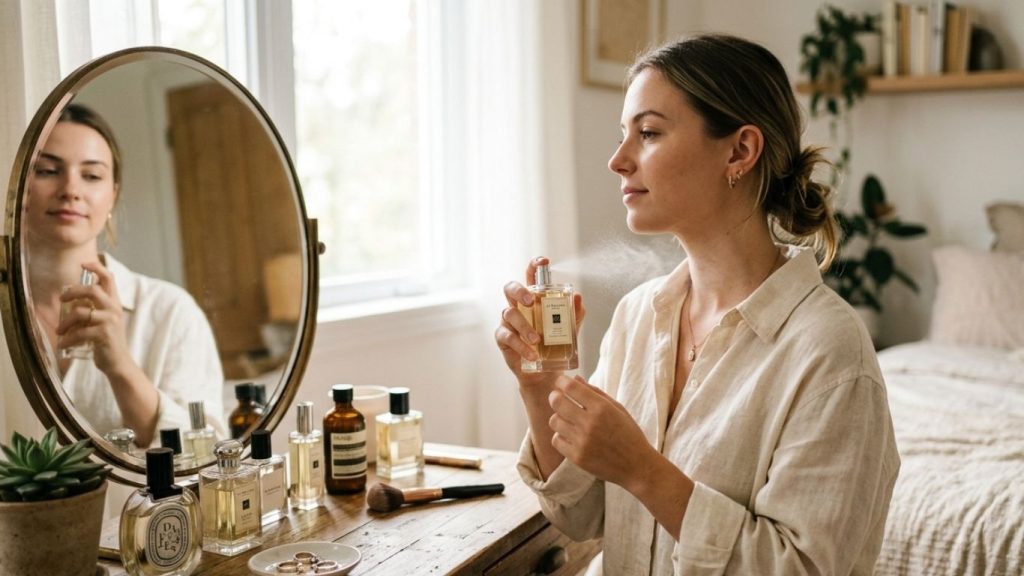
That uncertainty is why perfume often feels inconsistent. The same bottle can smell soft and close on one person, loud and room-filling on another. Instead of chasing a universal rule, it is more useful to understand what each spray is doing on your skin and in the air around you.
How many sprays of perfume is enough for most people?
For most fragrances, 2 to 4 sprays is the practical starting range. That is usually enough to create a noticeable scent bubble without turning the fragrance into the first thing people register about you.
But that range only works as a baseline. A sheer eau de cologne may need more. A dense extrait or powerful amber-woody scent may need less. If your skin tends to absorb fragrance quickly, two sprays might wear like one. If your skin runs warm and amplifies projection, two sprays can behave like four.
The goal is not maximum strength. The goal is appropriate performance. You want enough fragrance to be noticed at conversational distance, not enough to dominate a room before you enter it.
What changes how many sprays of perfume is enough
Fragrance concentration matters first
The concentration of fragrance oil changes how strongly a perfume projects and how long it lasts. Eau de cologne and many body mists are lighter, so 4 to 6 sprays may still feel restrained. Eau de toilette often sits in the 3 to 5 spray range for everyday wear. Eau de parfum usually performs well at 2 to 4 sprays. Parfum or extrait can be effective with 1 to 3.
This is not just about oil percentage on paper. Some eau de parfums are surprisingly airy, while some eau de toilettes push hard because of their materials. Still, concentration gives you a useful starting point before you test the fragrance on your skin.
Scent profile changes projection
Fresh citrus, tea, and aquatic scents usually read lighter in the air, even when you apply several sprays. Vanilla, oud, patchouli, tuberose, saffron, leather, and heavy musks often project more densely and linger longer.
That means two perfumes with the same concentration may need very different spray counts. A sparkling neroli fragrance might need an extra spray to feel present after an hour. A sweet resinous gourmand might need one less spray than you expect.
Skin chemistry affects both wear and volume
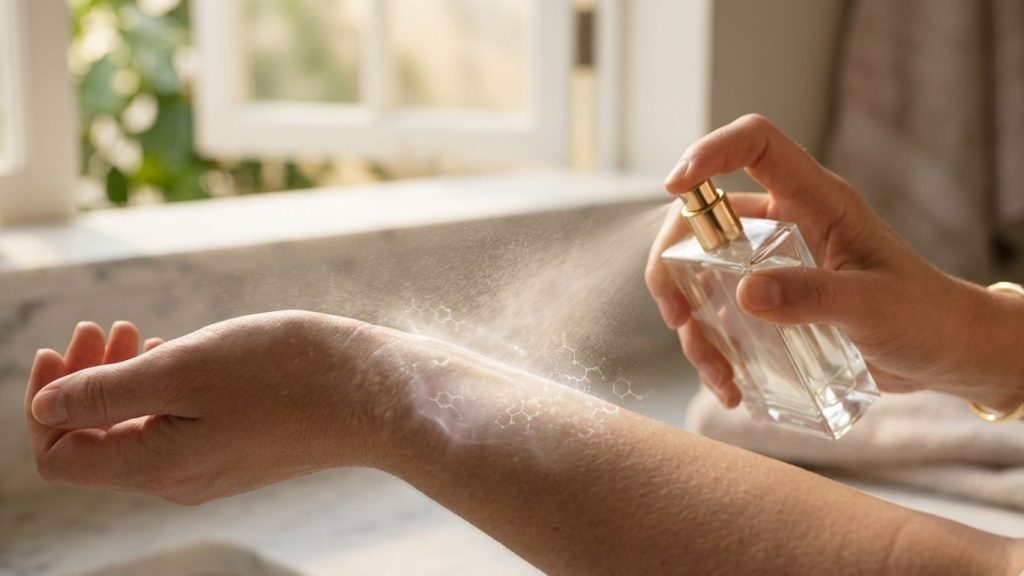
Skin chemistry is a major reason fragrance advice feels contradictory. Drier skin often shortens wear time, which can tempt people to overspray at the start. Oiler skin can hold and diffuse fragrance longer. Body temperature also matters. Warm skin tends to radiate scent more strongly, while cooler skin may keep it closer.
This is where personal testing beats generic rules. If perfumes routinely vanish on you, adding one spray may be enough. If they become stronger after thirty minutes, your skin may be amplifying the fragrance as it develops.
Environment changes what feels appropriate
A fragrance that feels perfect outdoors can become overwhelming in a car, office, classroom, or restaurant. Heat and humidity can increase projection. Cold weather usually reduces it, but richer perfumes can still become heavy indoors.
Context matters just as much as perfume strength. One to two sprays may be ideal for a medical setting or close-quarters workplace. Three to four may work for open-air social plans. Evening events can often support slightly more, especially if the fragrance is designed to wear close at first.
Where you spray matters as much as how much
Two sprays on the chest under clothing will wear very differently from two sprays on the neck. Placement changes projection, longevity, and how quickly you go nose-blind to your own perfume.
If you want moderate projection, apply to lower-heat areas like the chest or sides of the torso. If you want the scent to be more noticeable, pulse points like the neck and wrists can throw fragrance farther. Hair and clothing can extend longevity, but they can also hold scent longer than skin, which makes overspraying easier.
A simple way to control performance is to treat spray count and placement as one system. Three sprays in low-projecting areas can be softer than two sprays high on the neck.
A practical spray guide by situation
For daily wear, 2 to 3 sprays is usually the safest range. That often means one on the chest and one on each side of the neck, or one on the chest and one wrist spray shared between both wrists.
For work or scent-sensitive spaces, stay closer to 1 to 2 sprays, especially with strong eau de parfums, sweet gourmands, white florals, or woody ambers. In these settings, subtlety is part of wearing fragrance well.
For lighter fresh scents, 3 to 5 sprays can still feel balanced, especially if some are applied under clothing. Citrus and green fragrances often fade faster and project less aggressively.
For strong evening scents, 2 to 3 sprays is often enough. Rich perfumes do not need help announcing themselves. If you are wearing leather, oud, incense, or a dense vanilla, test restraint first and add only if needed.
For body mists and very light colognes, 4 to 8 sprays may be reasonable. These products are built for a softer effect and often need more coverage to last.
The biggest mistake: judging too fast
A common mistake is applying more fragrance within the first ten minutes because it feels faint. Early on, your nose is still adapting, and some perfumes bloom later as alcohol evaporates and heavier notes emerge.
Give a fragrance at least 20 to 30 minutes before deciding it was not enough. Then check its presence by stepping into fresh air or asking someone you trust whether it reads softly, moderately, or strongly at close range.
This matters because overspraying often happens before the perfume has fully settled. What feels weak right away can become much louder once the drydown starts.
How to find your personal ideal number
The most reliable method is to test one fragrance at a time with controlled adjustments. Start with 2 sprays and wear it in a normal setting. Pay attention to three things: how long you smell it, whether others can detect it at conversational distance, and whether it feels too quiet or too assertive for the setting.
The next time, change only one variable. Add one spray, or move one spray from the wrist to the chest. That gives you a clean read on what actually improved performance.
If you own several fragrances, do not assume your ideal spray count transfers across all of them. A skin scent musk and a syrupy amber should not be applied the same way. PerfumeOnSkin’s approach to performance is simple: test on skin, in context, with repeatable placement.
Signs you are using too much perfume
If people comment on your fragrance from several feet away, if you can still smell yourself strongly after twenty minutes without trying, or if the scent lingers heavily in a room after you leave, you are probably above the sweet spot.
Another sign is fragrance fatigue from your own application. Too much perfume can blur the details that made you like it in the first place. Instead of getting top notes, heart notes, and development, you get a loud cloud that flattens the composition.
Using less often improves the experience. Better diffusion, cleaner development, and fewer headaches for everyone around you.
When more sprays actually make sense
There are times when adding sprays is reasonable. Very sheer fragrances, dry skin, cold outdoor weather, and short-lived citrus compositions can all justify a higher count. Applying to moisturized skin can sometimes let you use less while getting better longevity.
You might also use more sprays if your goal is a closer all-over aura rather than a strong trail from one area. In that case, spreading 4 light sprays across the chest, shoulders, and forearms can wear more evenly than placing 2 heavy sprays on the neck.
That is the key distinction: more sprays are not automatically louder if the placement is controlled.
A good perfume routine is not about hitting a magic number. It is about matching spray count to formula, skin, and setting so the fragrance performs the way you intended. If you are unsure, start lower than you think, let the perfume develop, and adjust one spray at a time until it feels like part of you instead of an announcement.
Be the first to comment