
You can spray the same perfume on your wrist and on your shirt, then end up with what feels like two different fragrances by lunchtime. That is the real issue behind perfume on skin versus clothes: where you spray changes how a scent develops, how long it lasts, how far it projects, and even whether you still like it after a few hours.
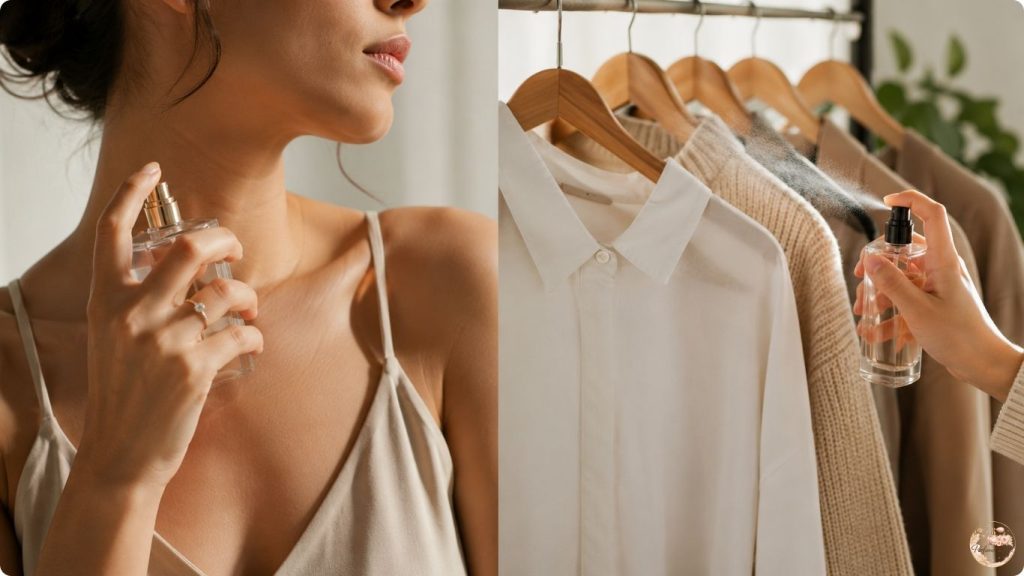
For most people, this is not a rule-based choice. It is a performance choice. If you want to smell the fragrance the way the perfumer intended, skin usually gives you the full evolution. If you want extra staying power or a cleaner, more linear scent trail, clothes often help. The best method depends on the fragrance formula, your skin chemistry, the fabric, and what you need that day.
Perfume on skin versus clothes: what changes?
Skin is warm, slightly oily, and chemically active. Fabric is cooler, drier, and much more stable. That difference matters because perfume is built from volatile aroma molecules that evaporate at different speeds.
On skin, heat helps the top notes lift faster. Citrus, herbs, aldehydes, and light florals tend to bloom quickly, then transition into the heart and base. Your natural oils, hydration level, and body temperature all influence how smoothly that transition happens. This is why a perfume can smell creamy on one person, sharp on another, and vanish early on someone with dry skin.
On clothes, there is less interaction. The scent usually changes more slowly and stays closer to what came out of the bottle. That can be a benefit if your skin tends to distort certain notes. It can also be a drawback if you love the depth and movement that happen during on-skin wear.
In practical terms, skin gives you development. Clothes give you stability.
Why perfume usually smells better on skin
Most fragrances are designed to be worn on the body. Perfumers generally evaluate how a fragrance opens, settles, and diffuses in the presence of body heat. That is where the architecture of the scent becomes fully visible.
If you have ever tested a perfume on a blotter, loved it, then found it flatter or more complex on your skin, that is the difference in action. Skin can amplify richness, soften rough edges, and reveal transitions between notes. Vanilla may turn warmer, woods may become smoother, and florals may feel more natural rather than sharp.
This is also why skin testing is essential before buying. A fragrance that performs beautifully on fabric may become overly sweet, too spicy, or unexpectedly powdery once it reacts with your skin chemistry. When the goal is scent selection, skin is the more reliable testing surface.
That said, better smelling does not always mean better performing. Some perfumes smell more nuanced on skin but disappear faster. Others smell more expensive on skin but project less than they do from a jacket or scarf.
Why clothes often make perfume last longer
Fabric does not absorb fragrance the same way skin does. There is less heat, less oil, and less chemical variation, so evaporation can slow down. That often means stronger longevity, especially for musks, ambers, woods, and heavier floral blends.
A perfume that lasts four to six hours on skin may cling to clothing all day, or even longer. This is one reason people think a scent has poor performance when the issue is really application placement. If you only spray pulse points and your skin runs dry or cool, the fragrance may not project the way you expect. One light spray on clothing can change that.
Clothes can also hold onto the base notes particularly well. The trade-off is that top notes may not sparkle as naturally. You may get a longer wear time, but less lift and less evolution.
For people focused on measurable longevity, clothing is often the easiest performance boost available.
When skin is the better choice
Skin is the better choice when you want to judge a fragrance accurately, enjoy its full dry-down, or create a scent bubble that feels personal rather than loud. It is especially useful with complex perfumes that are built around transitions, such as fragrances with a bright opening, a floral or spicy heart, and a resinous or woody base.
It also works better when you want subtle projection. Skin tends to keep fragrance closer to the body, especially after the first hour. That is ideal for work, close settings, or any situation where you want presence without leaving a strong trail.
Another advantage is control. You can place perfume on areas like the neck, chest, or forearms depending on how much diffusion you want. On moisturized skin, many fragrances also wear more evenly and smell rounder.
If your goal is to understand how a perfume truly performs on you, skin should be your primary reference point.
Best use cases for skin application
Skin makes the most sense for testing new perfumes, wearing complex niche-style compositions, and getting a natural scent cloud that moves with body heat. It is also the safer option when you are concerned about staining delicate garments.
When clothes are the better choice
Clothes are the better choice when longevity matters most, when your skin eats fragrance quickly, or when you want the scent to stay consistent. They are also useful in colder weather, when skin stays cooler and many perfumes project less than expected.
This approach can be especially effective with fresh perfumes that fade quickly on skin. A citrus aromatic or clean musk may feel short-lived on your wrist but remain noticeable for much longer on a collar, sweater, or outer layer.
Clothing also helps if your skin chemistry tends to sharpen certain notes. If patchouli turns muddy on you or white florals become too indolic, a fabric spray point may preserve a version of the fragrance you prefer.
The main caution is fabric safety. Some perfumes can stain silk, satin, white fabrics, and other delicate materials. Dark juices and oil-rich formulas are the highest risk.
Best use cases for clothing application
Clothing works well for outerwear, scarves, structured fabrics, and situations where you need all-day scent retention. It is also helpful for reviving a familiar perfume that underperforms on your skin.
The trade-offs most people miss
The question is not whether perfume on skin versus clothes has one correct answer. It is whether you want development or duration, intimacy or persistence, accuracy or stability.
Skin can smell better but fade faster. Clothes can last longer but smell flatter. Skin helps you evaluate the fragrance honestly. Clothes can make a mediocre performer seem stronger than it really is. If you are testing before purchase, clothing can actually mislead you because it may hide problems you would notice in real wear.
There is also a projection difference. On skin, diffusion rises with body heat and movement. On clothes, projection may feel steadier but less dynamic. Neither is automatically stronger. It depends on the fragrance concentration, the material, and how heavily you spray.
Then there is residue. Clothing can carry yesterday’s scent into today, especially on scarves, coats, and sweaters. That can interfere with a fresh application or create accidental layering.
The best strategy is usually both
For most fragrance wearers, the highest-performing method is not skin only or clothes only. It is a controlled combination.
Apply one or two sprays to moisturized skin where you want the fragrance to develop, such as the chest or sides of the neck. Then, if you need more longevity, add a light spray to clothing from a safe distance. This gives you the full on-skin evolution while using fabric as a support layer.
The key is restraint. Overspraying on both surfaces can make projection feel heavy and muddled, especially with sweet, woody, or amber-heavy perfumes. Start lighter than you think you need, then adjust based on the fragrance family and how it behaves after two to three hours.
If you are troubleshooting a weak performer, change one variable at a time. First moisturize skin. Then test skin-only wear. Then compare with one fabric spray. That gives you a repeatable method instead of guessing.
How to decide where to spray
If you are testing a new fragrance, use skin first. If you are trying to extend a favorite fragrance, add clothing second. If your skin changes perfume dramatically and not in a good way, clothing may be the better everyday surface. If you care most about the full artistic shape of the scent, stay focused on skin.
This is the kind of framework we use at PerfumeOnSkin.com because it turns a vague question into a practical one: what result are you trying to get from this fragrance today?
A perfume should work for your chemistry, your clothes, and your schedule. Treat application placement as part of performance, not an afterthought, and you will get more from the bottles you already own.



Leave a Comment