
You spray an EDT in the morning, and by lunch it feels faint. You wear an EDP the next day, and it is still sitting on your shirt at bedtime. That seems straightforward, but the EDT vs EDP longevity difference is not as simple as stronger equals longer.
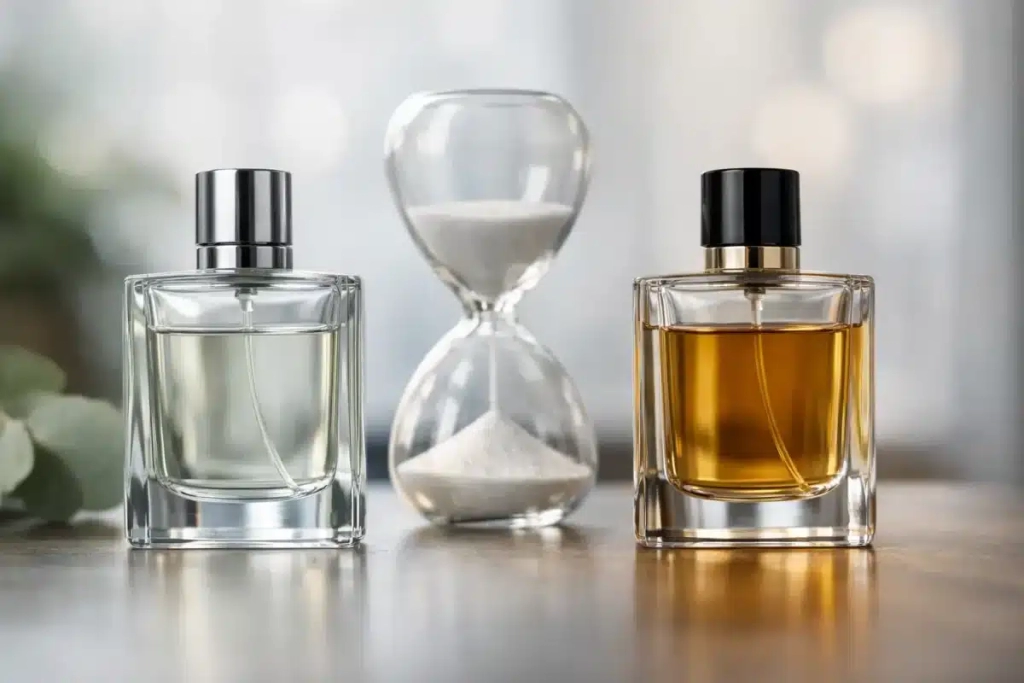
If you are trying to buy smarter, avoid disappointment, or get better performance from bottles you already own, concentration is only one part of the answer. Fragrance structure, skin type, climate, and even how you apply it can change the result more than the label on the bottle.
EDT vs EDP longevity difference at a glance
In most cases, EDP lasts longer than EDT. Eau de Parfum usually contains a higher concentration of aromatic compounds, while Eau de Toilette is typically lighter and more volatile. On skin, that often translates to EDP lasting around 6 to 8 hours and EDT lasting around 3 to 5 hours.
But those are only averages. Some fresh citrus EDPs disappear faster than woody EDTs. Some EDTs are designed to project brightly for a few hours and then fade cleanly, while some EDPs stay close to the skin but linger for much longer. Longevity and projection are related, but they are not the same thing.
So if your real question is, “Will EDP always perform better on me?” the honest answer is no. Usually longer, yes. Always better, no.
What EDT and EDP actually mean
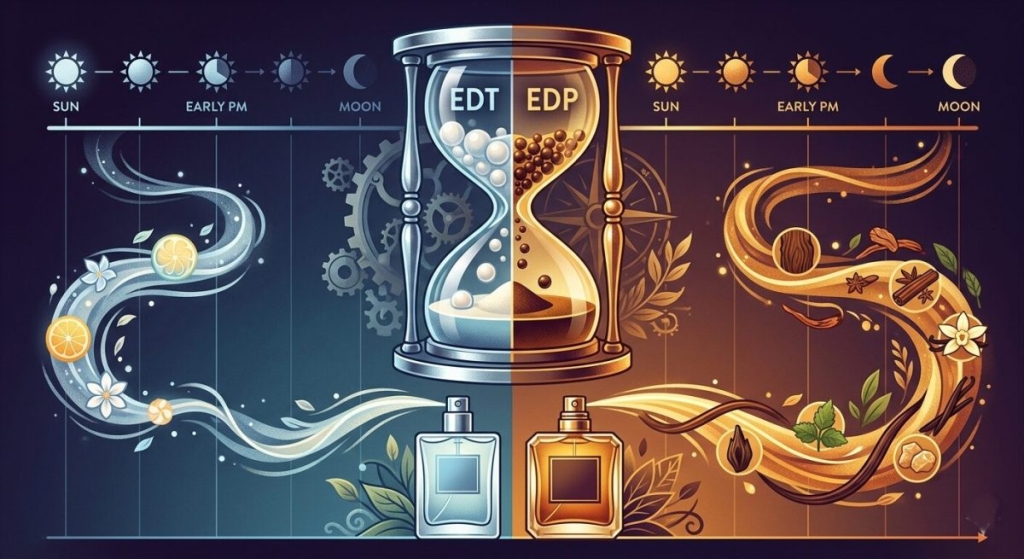
EDT and EDP are concentration categories. In simple terms, they describe how much perfume oil is diluted into alcohol and water. Eau de Toilette usually sits at a lower concentration than Eau de Parfum, which is why EDP is often richer, denser, and slower to evaporate.
That said, these labels are not perfectly standardized across every brand. One house’s EDT may perform like another house’s EDP. Brands also use concentration names as part of a scent’s positioning, not just as a strict technical formula. That is why comparing two fragrances by concentration alone can mislead you.
A better way to think about it is this: EDT usually aims for a lighter, more airy wearing experience. EDP usually aims for more depth, more body, and a longer scent trail on skin. The goal of the formula matters as much as the oil percentage.
Why EDP usually lasts longer
The reason EDP often outlasts EDT comes down to evaporation. Fragrance materials evaporate at different speeds. A higher concentration can slow that process, especially for heavier base notes like amber, woods, resins, musk, patchouli, and vanilla.
This is why many EDPs feel fuller in the dry down. As the top notes burn off, the richer base remains on skin longer. An EDT, especially one built around citrus, green notes, or watery florals, can smell vivid at first and then lose presence faster because more of its formula sits in those fast-moving materials.
Still, concentration does not override composition. A bright neroli and grapefruit EDP may still wear shorter than a cedar, vetiver, and tonka EDT. The ingredients inside the formula decide a lot.
The biggest mistake people make when comparing EDT and EDP
They expect the same scent, just stronger.
Sometimes that is true, but often EDT and EDP versions are reformulated. The EDP may add sweetness, woods, spice, or heavier musk. The EDT may emphasize freshness, sharpness, or cleaner florals. That means you are not only comparing wear time. You are comparing structure.
This matters because the version you prefer may not be the one that lasts longer. Some people love the sparkle and clarity of an EDT even if it fades sooner. Others want the slower, creamier development of an EDP because it feels more complete on skin.
If your priority is all-day wear, EDP often wins. If your priority is freshness, office safety, or warm-weather comfort, EDT may actually be the better choice.
How skin chemistry changes the EDT vs EDP longevity difference
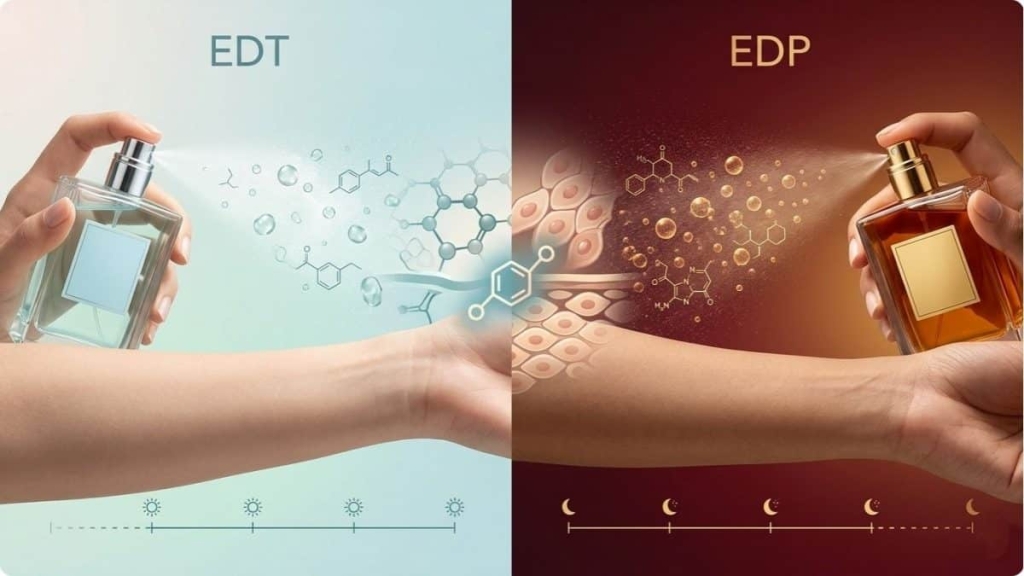
This is where performance becomes personal.
On dry skin, both EDT and EDP tend to disappear faster because there is less natural oil to hold fragrance. In that case, the longevity gap between the two may feel dramatic. An EDT might vanish in three hours, while an EDP gives you six or seven.
On oilier skin, fragrance often clings longer. The difference between EDT and EDP may narrow because both versions have more to grip onto. You may still get longer wear from the EDP, but not enough to justify a higher price if you already like how the EDT performs.
Skin temperature matters too. Warm skin throws scent more strongly, especially top and middle notes, but it can also make a fragrance burn through faster. That means a fresh EDT can seem lively and then disappear quickly, while an EDP with more base weight may feel more stable through the day.
This is one reason PerfumeOnSkin.com focuses so heavily on the on-skin experience. The bottle label gives you a category. Your skin decides the outcome.
Fragrance family often matters more than concentration
If you want to predict longevity accurately, look at the scent profile before you look at EDT or EDP.
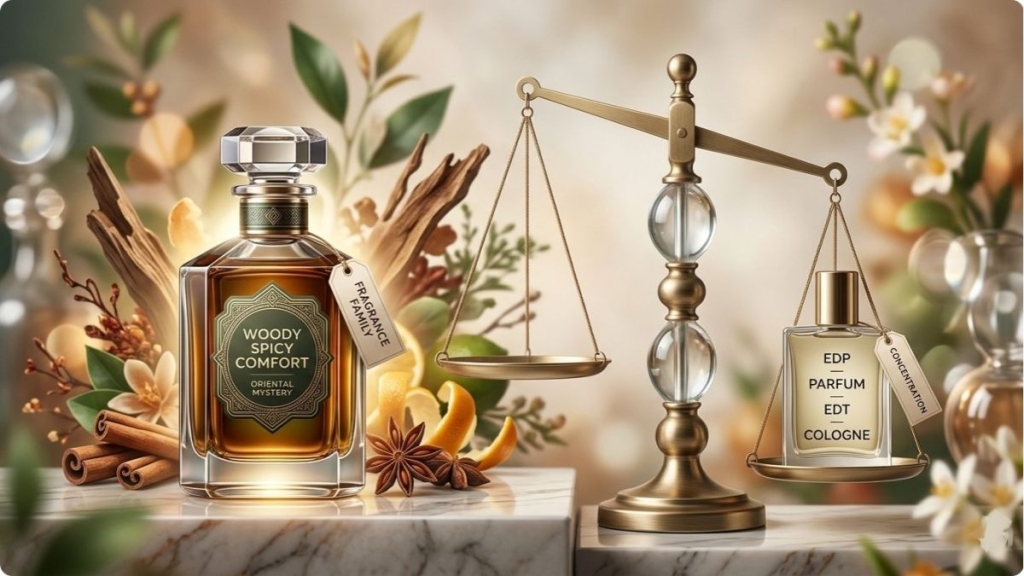
Fresh citrus, aquatic, green, and airy floral fragrances usually wear shorter. Woody, amber, gourmand, leather, and resinous fragrances usually wear longer. That pattern holds whether the bottle says EDT or EDP.
For example, a marine EDT may give you 4 hours of noticeable wear and then become a faint skin scent. A vanilla-amber EDT could easily outlast it. Meanwhile, a citrus EDP may smell richer than the EDT version but still not become an 8-hour powerhouse.
So when shoppers ask, “Should I buy the EDP because I want better longevity?” the better follow-up is, “What kind of fragrance is it?”
Projection vs longevity: do not confuse them
A common frustration is thinking a fragrance is gone because you stop noticing it. Sometimes it is not gone. It is just sitting closer to the skin.
EDTs often project more sharply in the opening. They can feel brighter and easier to smell in the first hour. EDPs may start denser and then settle into a slower, quieter dry down that lasts longer overall.
That means an EDT can seem stronger at first while actually lasting less time. An EDP can seem softer after a few hours but still be present on skin or clothing well into the evening.
If you are evaluating performance, do not only judge the first 30 minutes. Check at 2 hours, 4 hours, and 6 hours. Ask whether you want projection, longevity, or both. They are not identical goals.
When EDT is the better buy
There are real cases where EDT makes more sense.
If you live in a hot climate, prefer lighter scents, or wear fragrance mainly at work, an EDT may be easier to control. It can feel cleaner and less dense, especially in summer or in close indoor settings. Reapplying once during the day may still give you a better overall wearing experience than forcing an EDP that feels too heavy.
EDT is also a smart choice when the fragrance DNA is already strong. Some aromatic, woody, and spicy EDTs perform very well. Paying more for the EDP version may not give you a meaningful improvement if the EDT already lasts through your use case.
When EDP is worth it
EDP usually makes more sense when you want fewer reapplications, more depth, and better evening wear. It is especially useful if your skin tends to eat fragrance, or if you prefer richer dry downs that stay detectable longer.
It can also be the better value if you use fewer sprays. A well-performing EDP may cost more upfront but require less product per wear. That said, value only exists if you actually enjoy how the EDP smells on your skin. A longer-lasting version is not a win if it loses the character you liked in the EDT.
How to test longevity the right way
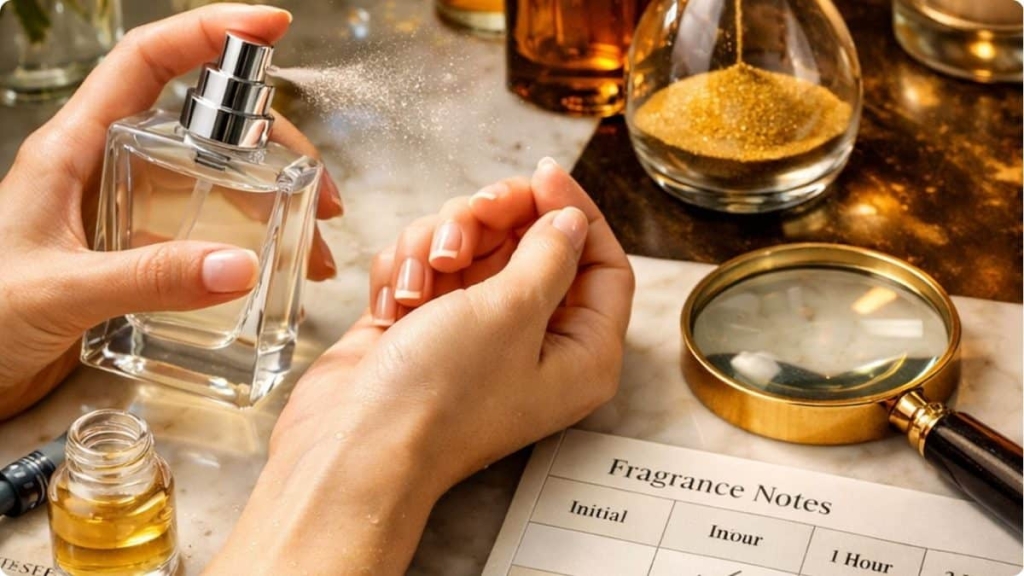
Do not compare EDT and EDP on paper strips only. Test each on skin, ideally on separate days with similar weather and routine. Spray the same number of times, in the same spots, and avoid layering with scented lotion unless that is how you normally wear fragrance.
Track three things: how long you can smell it yourself, when it becomes a skin scent, and whether the dry down still smells pleasant. A fragrance that lasts 8 hours but turns dull after 3 is not necessarily better than one that smells great for 5.
Clothing can help too, but skin should be your main benchmark if personal performance is the goal. Fabric often extends wear far beyond what your skin will do.
The practical answer most shoppers need
The EDT vs EDP longevity difference is real, and EDP usually lasts longer. But the label is not a shortcut to guaranteed performance. Skin type, fragrance family, climate, and formula design can all outweigh the concentration printed on the box.
If you want the safest strategy, test the exact version on your own skin and judge it by your day, not by averages. The best concentration is the one that gives you the scent experience you want for the hours you actually need.

Leave a Comment