
A perfume that disappears by lunch usually is not a sign that you bought the wrong bottle. More often, it is a mix of skin condition, formula type, spray placement, and expectation. The best fragrance longevity tips focus on those variables you can control, so you get more wear from the scents you already own.
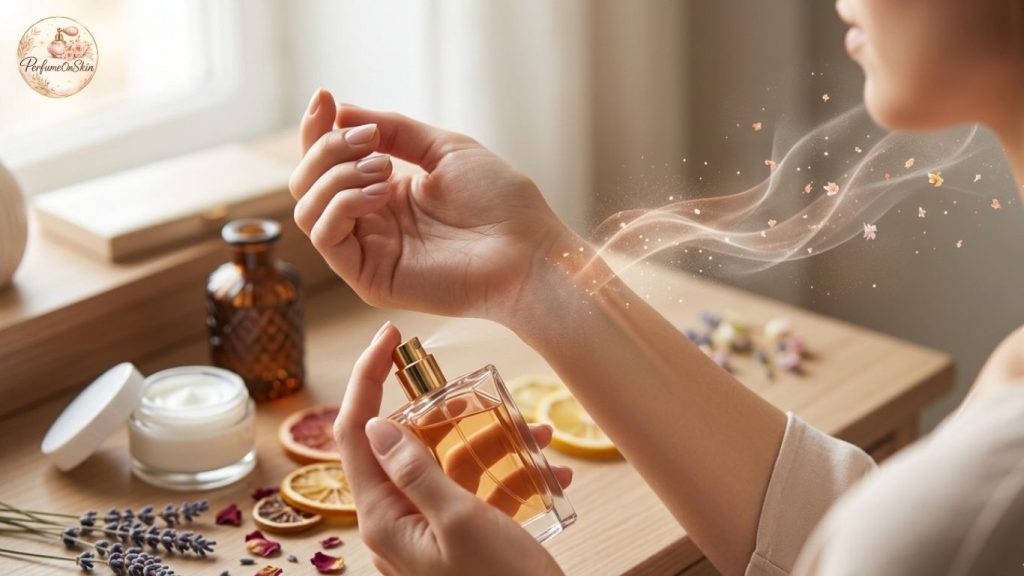
Some perfumes are built to stay close and fade gently. Others are dense, diffusive, and designed to linger on fabric for days. The goal is not to force every fragrance to perform like an extrait. It is to improve how long your fragrance lasts on your skin, in your climate, and in your routine.
Fragrance longevity tips start with skin prep
Dry skin is one of the most common reasons perfume vanishes quickly. Fragrance oils tend to hold better on moisturized skin because there is more for the scent to cling to. If your skin is dehydrated, the volatile top notes can burn off fast and the whole fragrance may feel thin within a couple of hours.
Apply an unscented moisturizer or body lotion before spraying perfume. This matters most on pulse points and any area where you usually apply fragrance. A lightweight lotion can help, but richer creams often give better hold, especially in winter or in dry indoor environments.
Petroleum jelly is often suggested as a fix, and it can help in small amounts, but it is not always the most elegant option. It may alter how evenly a fragrance sits on skin, particularly with delicate citrus or transparent floral scents. A simple unscented cream is usually the more reliable starting point.
Where you spray changes how long a fragrance lasts
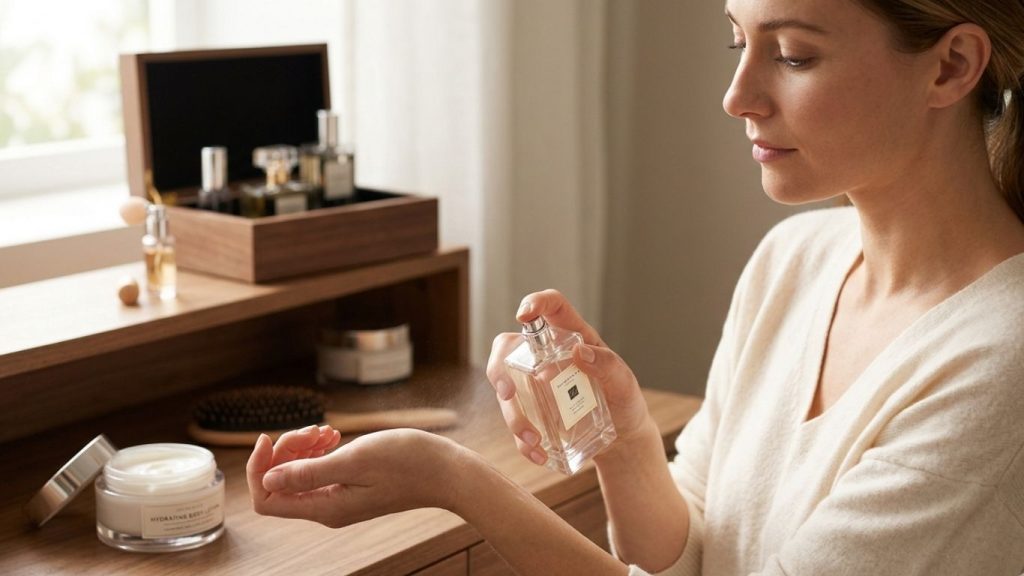
Pulse points are useful, but they are not the whole story. Wrists and neck get attention because they are warm, and warmth helps a fragrance project. The trade-off is that heat can also make a scent move through its stages faster.
If you want more longevity and a steadier drydown, spray on slightly cooler areas too, such as the chest, collarbone, forearms, or the back of the neck. These areas often hold fragrance longer without pushing it off the skin as quickly. For many people, one spray on the chest under clothing lasts better than two sprays on exposed wrists.
Hair and clothing can also extend wear, but use judgment. Hair holds scent well because it is porous, yet alcohol-heavy perfumes can be drying. A light mist onto a hairbrush is safer than spraying heavily onto hair directly. Clothing often keeps fragrance much longer than skin, especially with woods, musks, and ambers, but some formulas can stain silk or delicate fabrics. Test first.
Spray technique matters more than people think
One of the most common mistakes is rubbing wrists together after spraying. That does not literally crush the molecules in the dramatic way people sometimes describe, but it does create friction and heat, which can disturb the opening and make the scent develop unevenly. If you spray your wrists, let them dry on their own.
Distance matters too. Spraying from too far away creates a diffuse cloud and wastes product. Too close can oversaturate one spot. In most cases, a few inches from the skin gives the most even application.
More sprays do not always mean more longevity. Sometimes they only make the first hour louder. Longevity depends on formula concentration, composition, and what your skin does with it. If a perfume fades quickly, adding two extra sprays may help a little, but changing placement and skin prep usually does more.
Choose formulas that naturally wear longer
Not every fragrance family performs the same way. Citrus, green, aquatic, and many airy floral perfumes tend to feel brighter and lighter, but they often fade faster. Resinous ambers, vanilla, patchouli, oud, leather, and many woody-musky bases usually last longer because the materials themselves are less volatile.
Concentration can matter, but it is not a perfect shortcut. An extrait or parfum often lasts longer than an eau de toilette, yet composition still decides a lot. A sharp citrus extrait may still wear shorter than a dense woody eau de parfum. If performance is a priority, pay attention to the base notes and how the fragrance behaves after 30 to 60 minutes, not just the label on the bottle.
This is where testing on skin matters. A scent that lasts eight hours on one person may sit close and disappear in four on someone else. Skin chemistry does not change the identity of a fragrance entirely, but it can change evaporation rate, sweetness, dryness, and how strongly certain notes push forward.
Layering can improve longevity if you keep it simple
Layering is useful, but only when it has a clear purpose. If your goal is longer wear, start with matching or neutral supporting products rather than mixing several unrelated perfumes. An unscented moisturizer is the safest base. A body oil with very little scent can also help fragrance grip the skin.
If you own a matching body lotion or shower gel, use it strategically. These products usually reinforce the scent profile and make the overall impression last longer. The effect is often more noticeable in the first few hours, but it can also support the drydown.
Using two standalone perfumes together is more complicated. It can increase depth, but it can also muddy the structure and make performance harder to predict. If you layer perfumes, pair a lighter scent with a simple anchor, such as musk, vanilla, or soft woods. Test the combination at home before relying on it for a full day.
Environment affects performance more than bottle quality
Heat, humidity, wind, and indoor air all change how perfume wears. In hot weather, fragrance projects faster and can seem stronger at first, but the top and mid notes may vanish sooner. In cold weather, a perfume may feel quieter, yet richer base notes can linger longer on scarves, coats, and sweaters.
Air-conditioned offices are another common culprit. Dry indoor air can make skin lose moisture quickly, which reduces hold. If your fragrance seems to disappear at work but not at home, the environment may be part of the problem.
Your own nose also adapts. Olfactory fatigue makes you stop noticing a scent even while other people can still smell it. This happens often with musks, ambroxan, and some woody molecules. Before deciding a fragrance has poor longevity, ask someone you trust whether they can still detect it after a few hours.
Storage is part of longevity too
Poor storage shortens a perfume’s shelf life and can flatten its performance over time. Heat, direct sunlight, and repeated temperature swings gradually destabilize the formula. That can dull the opening, weaken projection, or make the scent smell off.
Keep bottles in a cool, dry, darker place. A bedroom drawer or closet shelf is usually better than a bright bathroom counter. Bathrooms look convenient, but steam and temperature changes are not ideal for fragrance. Good storage will not turn a light scent into a powerhouse, but it helps preserve the performance you paid for.
When reapplication is the smart move
Sometimes the right answer is simply to reapply. That is not failure. It is realistic use. Fresh citrus colognes, tea scents, and many skin scents are often meant to be enjoyed in shorter arcs.
If you know your perfume has a brief life, decant a small amount for midday touch-ups. Reapplying one spray after four or five hours can be more effective and more pleasant than overspraying at 8 a.m. in hopes of forcing an all-day result.
The most useful fragrance longevity tips are the ones you can repeat
If you want measurable improvement, change one variable at a time. Try moisturizer first. Then test different spray zones. Then compare skin versus clothing. This gives you a clearer read on what actually improves wear time for a specific fragrance.
At PerfumeOnSkin, the most reliable approach is always on-skin testing with realistic expectations. Some fragrances are naturally fleeting, some are quietly persistent, and some only reveal their strength after the opening settles. The trick is not chasing maximum power every time. It is learning how your perfume behaves on you, then using that knowledge to make it perform better when it counts.
A fragrance does not need to last 12 hours to be worth wearing. It just needs to last long enough, in the right way, for the life you actually live.

Leave a Comment