
What is sillage in perfume? This simple question opens the door to understanding why some fragrances feel powerful and memorable while others seem to fade the moment you walk away.

A scent can smell rich and captivating when you hold your wrist close, yet feel almost invisible in everyday movement. Another perfume might seem gentle on the skin but leave a soft, lingering trail that turns heads as you pass.
This contrast comes from sillage, the way a fragrance travels through the air and shapes the impression it leaves behind.
If you have ever wondered why one fragrance announces itself across a room while another stays close to the skin, sillage is the concept you are trying to measure. It is one of the most useful performance terms in fragrance, but it is also one of the most misunderstood.
What is sillage in perfume?
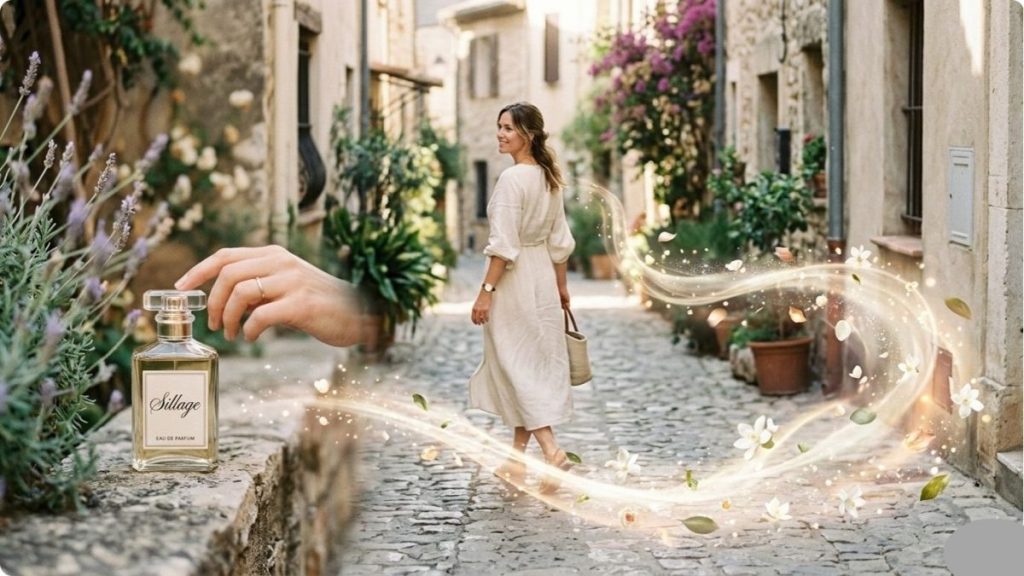
Sillage in perfume is the scented trail a fragrance leaves in the air as you move. The word comes from French and originally referred to the wake left behind by a boat. In fragrance, it describes what other people notice after you pass by, stand up from a chair, or enter and leave a space.
That makes sillage different from simply smelling strong on your own skin. A perfume can be intense when you press your nose to your wrist but still have modest sillage. Another can feel smooth and controlled on skin while creating a clear, elegant trail around you. For everyday wear, that distinction matters more than many shoppers realize.
| Aspect | Explanation |
|---|---|
| Definition | Sillage is the scent trail a perfume leaves in the air as you move. |
| How It Forms | It develops when fragrance molecules lift from the skin and disperse into the surrounding space. |
| What Affects It | Concentration, ingredients, skin chemistry, climate, and application technique. |
| Why It Matters | It determines whether a perfume feels intimate, noticeable, or boldly present. |
| Common Misconception | Strong sillage does not always mean strong longevity; they are related but separate qualities. |
Sillage is also not automatically a sign of quality. Some people want a close-wearing fragrance for work, travel, or scent-sensitive settings. Others want a perfume with more presence for evenings, events, or outdoor wear. The goal is not always more sillage. The goal is the right amount for your use case.
Sillage vs projection vs longevity

These three terms are often grouped together, but they are not interchangeable.
Sillage is the trail
Sillage is what lingers in your wake. Think of it as the perfume’s movement through space after you move through it. If someone says, “I could smell your perfume after you walked past,” they are describing sillage.
Projection is the radius
Projection is how far a fragrance radiates outward from your body while you are standing still. A scent with strong projection creates a more obvious scent bubble. People can smell it around you without needing to be very close.
A perfume can project strongly in the first hour and then settle into softer sillage later. Or it can project modestly but still leave a refined trail when you move. This is why a single test spray in a store rarely tells the full story.
Longevity is the wear time
Longevity is how long the fragrance remains detectable on skin, clothing, or hair. A perfume may last eight hours but have low sillage after the first ninety minutes. Another may have dramatic sillage early on and then disappear faster than expected.
For practical perfume buying, you need to evaluate all three. Shoppers often say a fragrance is “weak” when the real issue is that it has low projection, short sillage, or poor performance on their skin chemistry, not necessarily poor longevity overall.
5 Perfumes Known for Exceptional Sillage
| Perfume | Gender | Scent Profile | Why the Sillage Stands Out | Ideal For |
|---|---|---|---|---|
| Maison Francis Kurkdjian – Baccarat Rouge 540 | Unisex | Amber, woody, airy sweetness | Radiates far from the skin and lingers for hours | Evening wear, special occasions |
| Dior – Sauvage Elixir | Men | Spicy, aromatic, woody | High concentration with powerful projection | Night outings, bold presence |
| YSL – Libre Intense | Women | Floral, vanilla, amber | Warm ingredients that bloom in heat | Day‑to‑night wear |
| Tom Ford – Black Orchid | Unisex | Dark floral, patchouli, chocolate | Dense notes that create a dramatic scent trail | Glamorous events |
| Mugler – Alien | Women | Jasmine, amber, woody | Radiant jasmine that projects strongly | Confident, statement‑making wear |
What affects sillage on skin?
Sillage is not determined by the bottle alone. The formula matters, but so do your skin, your application method, and the environment.
Fragrance concentration and composition
In general, perfumes with higher concentrations can create more lasting presence, but concentration alone does not guarantee stronger sillage. The structure of the fragrance matters more than many labels suggest.
Ingredients with greater diffusion tend to create a more noticeable trail. Florals like jasmine, white musks, amber woods, patchouli, and certain modern aroma molecules can all increase perceived sillage. By contrast, fragrances built around soft musks, skin scents, delicate tea notes, or airy citrus often feel more intimate.
Top notes can create an early burst, but sillage often depends on how the heart and base behave in air. A perfume that opens bright and then collapses quickly may smell impressive at first spray yet perform quietly after that.
Your skin chemistry

This is where fragrance gets personal. Oilier skin often helps perfume cling longer and release more gradually, which can improve both longevity and the character of the trail. Drier skin may cause a scent to fade faster or sit closer to the body.
Skin temperature matters too. Warmer skin can make fragrance evaporate and radiate more quickly, which may boost projection and early sillage. The trade-off is that the perfume can burn through its most volatile notes faster.
Body chemistry also changes how certain notes read in the air. A woody amber may feel smooth and expensive on one person but sharp and louder on another. The same bottle can produce different sillage profiles depending on the wearer.
Where and how you apply it
Pulse points can increase lift because they are warmer, but they are not always the only answer. Spraying on the sides of the neck, upper chest, or shoulders often creates a more noticeable scent cloud than spraying only on wrists.
Clothing can extend scent and sometimes improve the trail, especially with woods, musks, and gourmand bases. Still, it depends on the fabric and the formula. Some perfumes bloom better on fabric, while others smell flatter or more synthetic off skin. Delicate fabrics can also stain.
The number of sprays matters, but more is not always smarter. Overspraying can create a blunt, heavy effect rather than a refined trail. Good sillage is often about diffusion, not volume.
Climate and setting
Heat and humidity usually amplify fragrance movement. In cold weather, many perfumes feel quieter and closer to the skin. Air flow matters too. A scent may seem restrained in still indoor air but become more noticeable when you are walking outdoors.
This is why a perfume that feels perfect in a winter department store test can become overwhelming in summer.
How to tell if a perfume has strong sillage
The hardest part of evaluating sillage is that you are the least reliable judge once you start wearing a fragrance regularly. Nose fatigue sets in quickly, especially with musks, ambers, and woody molecules.
A better test is to apply the fragrance as you normally would, then pay attention to real-world moments. Do you notice it when you move your hair, take off a jacket, or re-enter a room after stepping out? Do other people catch it as you pass, not just when they hug you? Those are useful clues.
You can also test it on clothing or skin and leave the room for a few minutes. When you return, notice whether there is a gentle trace in the air. That is closer to sillage than simply smelling your wrist every half hour.
If you are comparing perfumes, test one per day rather than spraying several at once. Sillage gets hard to judge when multiple scent clouds overlap.
How to increase sillage without overdoing it
If you like a perfume but wish it left more of a trail, a few adjustments can help.
Start with moisturized skin. Unscented lotion or body cream usually gives fragrance something to hold onto, especially if your skin runs dry. Then spray strategically rather than excessively. The upper chest, back of the neck, and outer clothing layers often create better movement than stacking ten sprays on one spot.
Layering can also help, but it needs restraint. If a perfume already has a strong base, adding another scented product can make it muddy rather than more diffusive. Matching body products tend to work best because they reinforce the structure instead of competing with it.
Sometimes the real fix is choosing a formula with naturally better diffusion. If your favorite scent profile always disappears on you, it may not be your technique. You may simply prefer note families that wear softly. In that case, look for similar compositions built with stronger musks, woods, or resins.
When lower sillage is actually better
A lot of fragrance advice treats stronger performance as the obvious win. That is not always true.
Low to moderate sillage is often ideal for offices, close-contact work, airplanes, medical settings, and hot weather. It also suits people who want a more private fragrance experience. A skin scent that stays mostly within your personal space can feel polished and expensive without dominating the room.
This is where expectations matter. If you buy a clean musk or a light citrus and expect nightclub-level trail, you will think the perfume failed. It may actually be doing exactly what it was designed to do.
On the other hand, if you want your fragrance to register in social settings, understanding sillage helps you avoid blind buys that smell beautiful but vanish into the background on your skin.
At PerfumeOnSkin.com, this is the real value of performance language. Terms like sillage become useful when they help you match a fragrance to your body chemistry, your setting, and the result you actually want.
The best perfume is not the one with the loudest trail. It is the one that leaves the right impression at the right distance.

Leave a Comment