
You spray a perfume that smells smooth and balanced on paper, then ten minutes later on your wrist it turns sharp, stale, metallic, or vaguely like vinegar. That shift is frustrating, especially when you liked the scent in the bottle and expected the same result on skin.
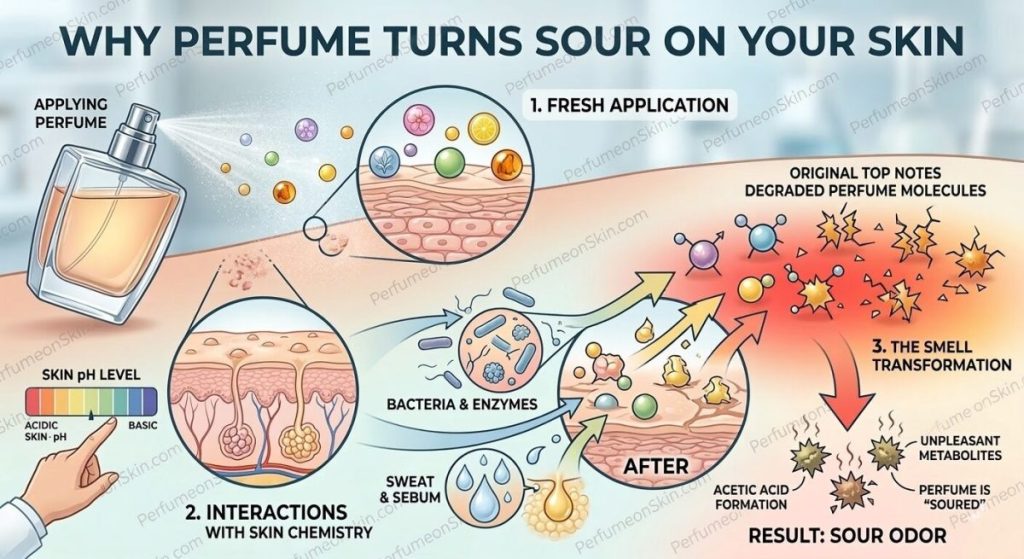
If you are dealing with perfume turning sour on skin, the problem is usually not random. It tends to come from one of four places: your skin chemistry, the perfume’s structure, how and where you apply it, or the condition of the bottle itself. Once you know which factor is causing the change, you can usually improve the wear experience without giving up on fragrance altogether.
What “sour” usually means in fragrance
When people say a perfume smells sour on their skin, they rarely mean one exact odor. Sour can describe a tart citrus note that becomes harsh, a floral that turns sweaty, a musk that reads acidic, or a woody base that develops an off, stale edge.
That matters because the fix depends on what kind of sourness you are smelling. A bright lemon top note fading too sharply is different from a perfume that develops a fermented, almost spoiled effect after an hour. In practical terms, sourness usually shows up as one of three patterns: the opening goes acidic, the heart turns funky, or the dry down becomes flat and stale.
Why perfume turning sour on skin happens
Skin is not a neutral surface. It has oil, sweat, salt, bacteria, pH variation, and temperature. A fragrance formula meets all of that at once.
Perfume does not just sit on top of skin unchanged. As alcohol evaporates, different aroma molecules rise and fade at different speeds. On one person, that transition feels clean and blended. On another, one note gets amplified while the rest disappear too quickly. When the wrong notes dominate, the result can smell sour.
Skin oil and sweat can distort the balance
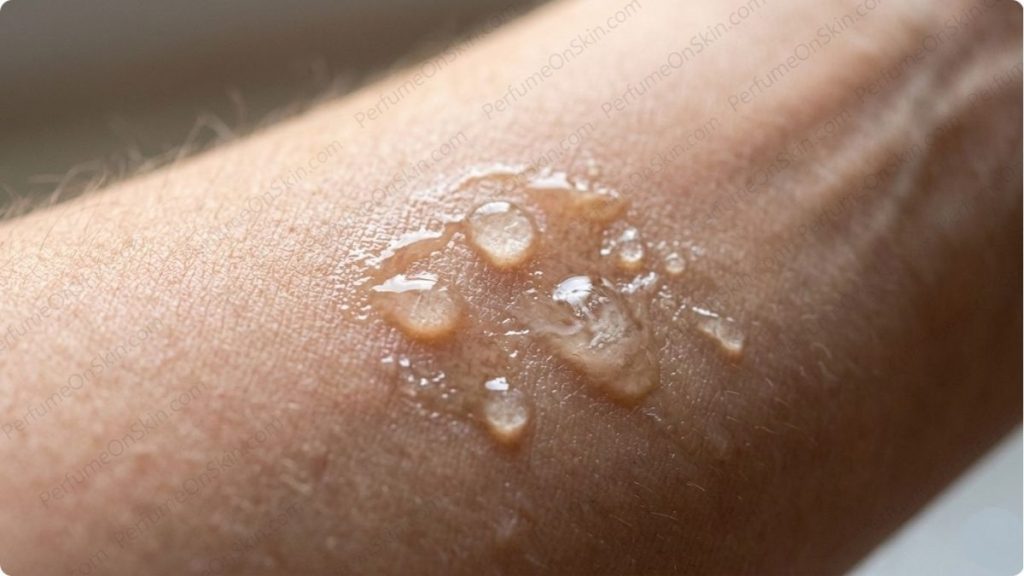
Oily skin often helps fragrance last longer, but it can also push certain notes harder than intended. Sweet fruits, some white florals, and certain musks can become heavier or more fermented on warm, oily skin. On the other side, very dry skin can burn through top notes fast, leaving an abrupt, sour-leaning middle that feels unbalanced.
Sweat is another common trigger. Fresh sweat itself is not always the issue. The bigger factor is how fragrance materials interact with salty moisture and skin bacteria over time. This is why a perfume can smell fine when first sprayed, then become unpleasant after commuting, working out, or spending hours in heat.
Skin chemistry affects specific notes more than others
Not all notes misbehave equally. Citrus, blackcurrant, green notes, marine accords, some aldehydes, and certain synthetic musks are frequent trouble spots when a fragrance turns sour.
Citrus-heavy perfumes are a classic example. They smell sparkling at first, but on some skin they can dry down into something acidic and thin. Blackcurrant can read elegant and tart on one person, but catty or sour on another. White florals can become indolic or sweaty if the composition is already close to that line.
This does not mean your skin is “bad” for perfume. It means your skin is revealing parts of the formula more strongly than a blotter does.
Sometimes the perfume itself is the problem
If multiple fragrances smell normal on you but one specific bottle keeps turning sour, look at the perfume before blaming your skin.
Oxidation changes the scent
Perfume exposed to heat, light, and air can oxidize. When that happens, fresh notes often degrade first. Citrus can smell sour instead of lively. Florals can lose softness. The whole structure may feel flatter and sharper at the same time.
This is especially common with older bottles, partially used bottles with a lot of air in them, and fragrances stored in hot bathrooms or near windows. If the same perfume used to smell better on you and now consistently smells off, storage is worth investigating.
Reformulation and batch variation can matter
Some readers notice a perfume turning sour on skin only after repurchasing a favorite. In that case, the issue may be a new batch or revised formula rather than a sudden change in your body chemistry. This is harder to prove without side-by-side testing, but it is a real possibility, especially with fragrances that rely on fresh top notes or delicate florals.
Application mistakes that make sourness worse
Even a well-made perfume can wear poorly if applied under the wrong conditions.
Spraying on overheated or damp skin
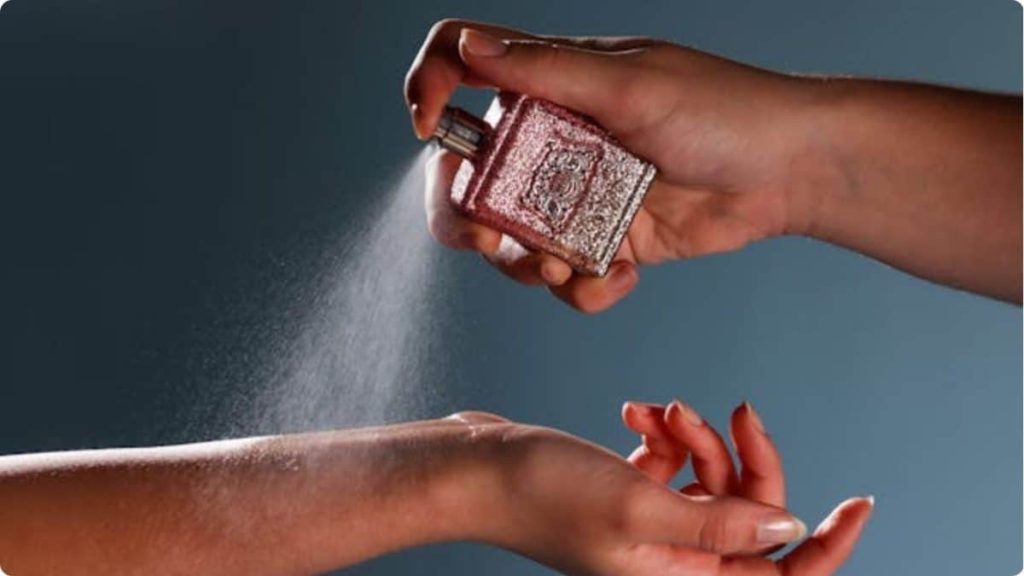
Hot skin pushes evaporation faster. That can make a fragrance feel louder at first, but it often shortens the balanced part of the wear and exposes rougher edges sooner. If you apply perfume right after a hot shower, during high humidity, or when you are already sweating, sourness can become more noticeable.
Damp skin is tricky too. Moisturized skin generally helps perfume, but water or sweat on the surface can interfere with how the opening develops.
Applying on top of scented products
Body wash, lotion, deodorant, and laundry detergent can all shift a fragrance. If your lotion has citrus, coconut, vanilla, or floral notes, it can clash with perfume and create a sour or spoiled effect that is not coming from the perfume alone.
This is one reason a scent can smell bad on your neck but fine on your forearm. Different areas of the body pick up different product residue.
How to test whether your skin is the issue
The fastest way to diagnose the problem is comparative testing.
Spray the perfume on a blotter or tissue, on clean bare skin, and on fabric. If it smells sour only on skin, skin chemistry or application conditions are likely responsible. If it smells sour on fabric too, the bottle may be compromised or the formula simply does not suit your nose.
Then test placement. Try one spray on the inner forearm, one on the back of the hand, and one on clothing. If the scent goes sour only on pulse points, warmth is likely accelerating the problem. If it smells better on clothing than skin, that tells you the formula may still be wearable with a different strategy.
For readers who want a more repeatable method, test on unscented, moisturized skin one day and dry skin another day. This isolates whether dehydration is causing the perfume to collapse too quickly.
How to stop perfume from smelling sour on your skin
The fix depends on the cause, but several adjustments improve results for most people.
Start with skin prep. Apply fragrance to clean skin that is cool and fully dry, then use a light, unscented moisturizer if your skin runs dry. This gives the perfume a more stable surface and slows down the rough drop-off from top to middle notes.
Next, change placement. If your neck and wrists run warm, spray the sides of the arms, chest under clothing, or even the back of the knees. These areas can produce a smoother evaporation curve. Clothing is another useful option if the fragrance consistently turns sour on skin but smells good in the air.
Reduce the dose before you give up on the scent. Some perfumes smell sour because they are oversprayed, not because they are fundamentally incompatible. A dense floral, fruit-chouli, or musky fragrance can become acidic and crowded when applied too heavily.
Finally, match the fragrance family to your skin behavior. If bright citrus, marine, or tart fruity perfumes often go sour on you, test softer structures instead – woods, iris, tea, vanilla-amber, or creamy florals. If sweet scents become cloying and fermented, try drier compositions with cleaner musk or aromatic notes.
When to stop trying to make it work
There is a difference between improving performance and forcing a mismatch. If a perfume repeatedly turns sour across multiple tests, in different weather, on moisturized skin, and from a fresh bottle, it may simply not be a fit for your chemistry.
That is not failure. It is useful selection data.
The goal is not to make every perfume work. The goal is to identify patterns in what your skin supports best. Once you notice that certain note families consistently go sharp, stale, or acidic on you, future shopping gets easier and blind buys get less risky. That is the kind of practical filter we focus on at PerfumeOnSkin.com because better fragrance outcomes usually come from pattern recognition, not luck.
If your perfume is turning sour on skin, treat it as a diagnostic clue. Test the bottle, test the placement, test your skin prep, and pay attention to which notes are causing the shift. The more precisely you define the problem, the faster you find scents that smell like themselves on you – and stay that way.



Leave a Comment