
You spray a perfume in-store, love it, bring it home, and a week later it smells flatter, sharper, or disappears faster than expected. Most people blame skin pH first. It sounds scientific, and it gets repeated constantly in fragrance advice. But if your goal is better performance, pH is only part of the picture – and usually not the biggest part.
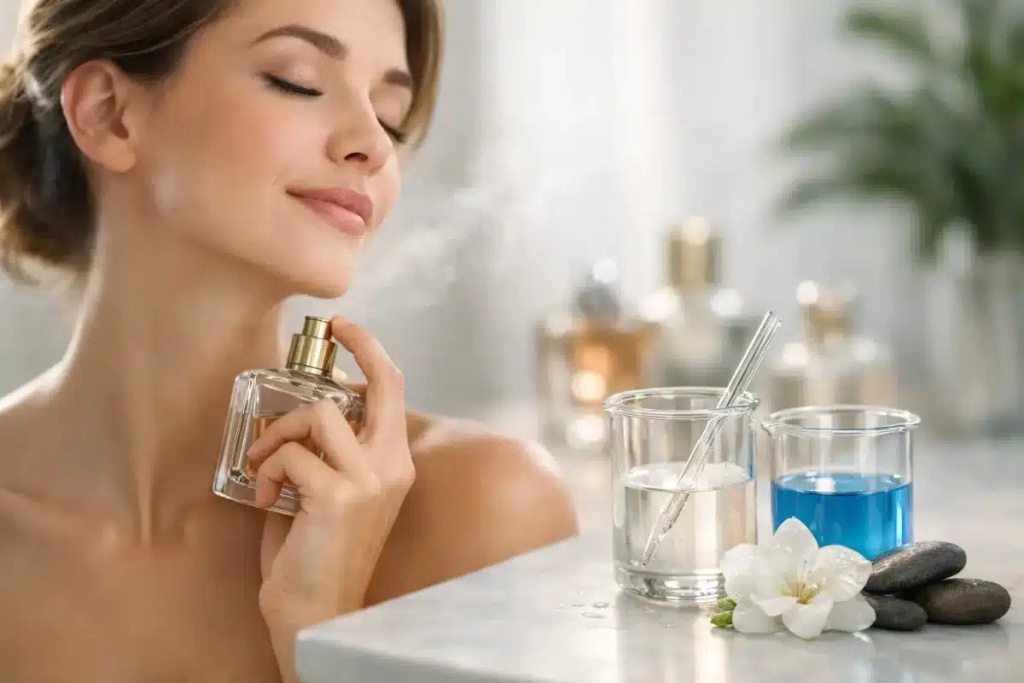
Does pH affect perfume on skin?
Yes, skin pH can affect perfume on skin, but usually less than people think. Healthy skin is slightly acidic, typically sitting around 4.7 to 5.75. That acidity helps support the skin barrier. It may influence how certain fragrance materials behave on the surface, especially delicate notes, but it is rarely the main reason a perfume smells dramatically different from one person to another.
What matters more in day-to-day wear is your skin’s oil level, moisture level, temperature, grooming products, and how quickly the fragrance evaporates from your skin. If a scent turns soapy, sour, thin, or vanishes within an hour, pH might play a small role. More often, though, the bigger drivers are dryness, excess oil, sweat, or the formula itself.
That distinction matters because it changes what you should do next. If you assume pH is the problem, you may keep switching perfumes when a simple change in application or skin prep would fix the issue.
Why the “skin pH” explanation gets overused
Skin chemistry is real, but “pH” often gets used as a shortcut for every fragrance mismatch. It becomes an easy answer for complex behavior that actually comes from several variables working together.
Perfume is a volatile mixture. Once it hits skin, alcohol flashes off, top notes lift, heart notes emerge, and base notes settle depending on heat, skin lipids, hydration, and environmental conditions. Your skin is not a neutral testing strip. It is warm, active, and constantly changing across the day.
That means two things can both be true. First, skin acidity can slightly shift how a fragrance opens or develops. Second, the difference many people notice is usually not caused by pH alone. When fragrance advice treats pH as the whole explanation, it oversimplifies what is actually happening on skin.
What affects perfume more than pH
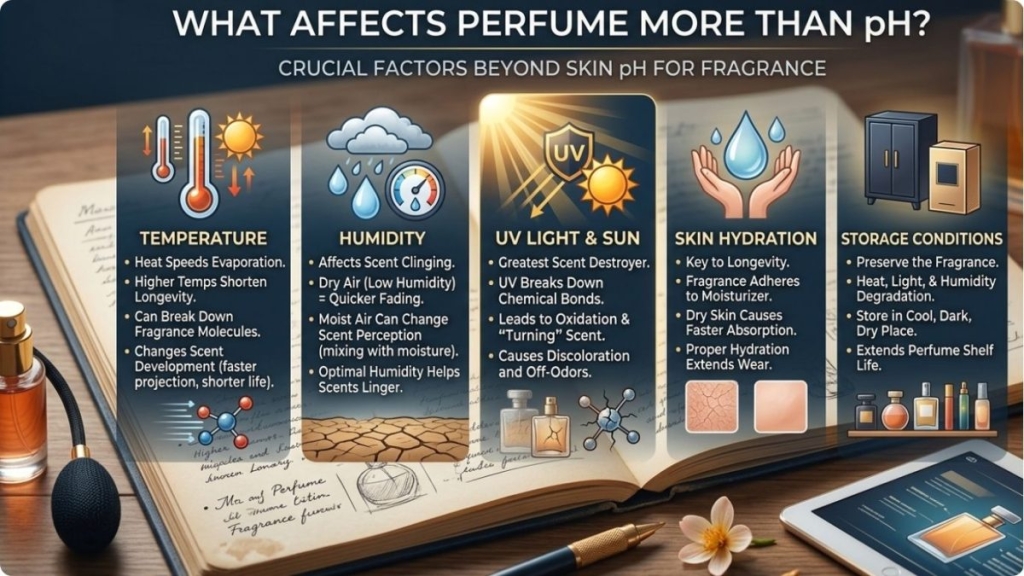
Skin moisture
Dry skin is one of the biggest reasons perfume underperforms. Fragrance tends to evaporate faster from dry skin because there is less moisture and oil to hold onto the aromatic compounds. The result is often weaker projection, shorter wear time, and a rougher opening that makes citrus, green, or airy florals feel more fleeting.
On moisturized skin, the same perfume often smells rounder and lasts longer. This is one reason people report different results from the exact same bottle.
Skin oil and sebum
Oilier skin often holds fragrance longer, especially richer bases like amber, vanilla, woods, musk, and resins. That does not always mean it smells better. Extra oil can amplify sweetness or make a dense composition feel heavier than intended. If you have oily skin, a fresh fragrance may bloom nicely while an already rich gourmand may become too thick after a few hours.
Skin temperature
Warm skin pushes evaporation faster. That can improve projection at first, but it may also burn through top notes quickly. Cooler skin often slows development, which can make a perfume seem quieter, tighter, or less expressive. This is why pulse points can behave differently, and why a fragrance may smell stronger after activity than when first applied in a cool room.
Sweat and environment
Sweat, humidity, and heat can all change how perfume reads. A clean musk may feel fresher in dry weather and more humid, salty, or sharp in summer heat. That is not necessarily a pH issue. It is often a wear-condition issue.
Product interactions
Soap residue, scented lotion, body oil, sunscreen, and deodorant all affect what you smell. If your perfume behaves unpredictably, look at the full routine. Fragrance layered over strongly scented skincare can shift more than pH ever will.
When pH may actually matter
There are cases where skin pH has a more noticeable effect. If your skin barrier is disrupted from over-exfoliation, harsh cleansers, active treatments, or irritation, your skin surface may behave differently than usual. In that state, perfume can smell sharper, less stable, or more chemically harsh.
Some fragrance families also seem more sensitive on certain skin types. Bright citrus, aldehydes, light florals, and aromatic notes may show small shifts more clearly because they are already volatile and delicate. Deep woods, resins, and dense gourmands tend to be more forgiving because the base materials dominate the dry down.
So, does pH affect perfume on skin in a real-world sense? Yes, but usually at the margins. It can nudge a fragrance. It rarely rewrites it.
Skin Chemistry vs. Fragrance Performance: The Real Factors That Change How Perfume Smells
| Factor | Influence Level | Evidence‑Based Explanation |
|---|---|---|
| Skin pH | Low–Moderate | Most skin sits between pH 4.5–5.5. Fragrances are formulated to remain stable across this range, so pH causes only subtle shifts in how notes evaporate. |
| Skin Oils (Lipids/Sebum) | High | Natural oils act as a carrier for fragrance molecules. Oily skin holds scent longer, while dry skin allows faster evaporation. |
| Skin Hydration | High | Well‑hydrated skin slows evaporation and supports smoother diffusion. Very dry skin loses top notes quickly because the alcohol phase disappears faster. |
| Body Temperature | Moderate–High | Warmer skin increases volatility, making top notes project more strongly but fade sooner. Cooler skin slows diffusion. |
| Skin Microbiome | Moderate | Bacteria on the skin break down sweat and oils into compounds that mix with perfume, contributing to each person’s unique scent profile. |
| Diet & Medications | Variable | Certain foods and medications release volatile compounds through the skin, which can subtly influence how a fragrance develops. |
How to tell if pH is the issue or something else
The easiest way to test this is to compare the same perfume in three ways. Spray it on a blotter, on clean bare skin, and on moisturized skin. Wear each version for several hours.
If the blotter smells balanced but your skin version turns odd immediately, skin interaction is involved. If the moisturized skin version performs much better than bare skin, dryness is likely the bigger issue. If both skin versions smell similar but fade too fast, your problem may be volatility, low concentration, or under-application rather than pH.
You can also test different areas of your body. The wrist, inner elbow, chest, and back of the hand can all give different results because temperature and skin texture vary. If one area consistently performs better, that is useful practical information, even if you never isolate pH with scientific precision.
What to do if perfume smells off on your skin
Start with skin prep. Apply an unscented moisturizer and let it absorb before spraying. This is the simplest way to improve longevity and smooth out a rough opening.
Then adjust placement. If your wrists run hot or get washed often, move your application to the inner elbows, collarbone, or chest. Fabric can also help, though it changes the scent profile and may stain delicate clothing.
Next, look at concentration and fragrance style. If sheer citrus colognes vanish on you, try an eau de parfum or a composition with stronger woods, musks, or resins in the base. If sweet perfumes become too dense, test fresher structures with less syrupy dry downs.
Finally, stop judging a perfume from the first five minutes alone. A skin interaction that seems odd in the opening may settle beautifully after the alcohol evaporates and the heart notes emerge. The reverse is also true. A pretty top can collapse quickly if your skin does not support the base well.
Choosing perfumes with skin chemistry in mind
If you know your skin runs dry, prioritize fragrances with a substantive base and expect to moisturize before applying. If your skin is oily or warm, be careful with heavy gourmands, dense ambers, and very sweet vanilla blends unless you specifically want that amplified effect.
For shoppers trying to avoid expensive mistakes, testing by fragrance family is often more useful than obsessing over pH. Ask which structures consistently work on your skin. Do musks last? Do citruses disappear? Do white florals turn sharp? Patterns like these help you choose better than a vague idea that your “pH is wrong.”
This is where a performance-focused approach matters. At PerfumeOnSkin.com, the most useful question is not whether one variable exists. It is which variable you can control to get better wear.
Best Designer Perfumes That Stay Consistent Across Skin pH Levels
| Perfume | Gender | Why It Stays Stable | Fragrance Style |
|---|---|---|---|
| Dior Sauvage Parfum | Men | Heavy woods & resins resist pH‑related shifts | Woody‑Amber |
| Bleu de Chanel EDP | Men | Aromachemicals (Iso E Super, incense) remain stable | Aromatic‑Woody |
| Prada Luna Rossa Carbon | Men | Ambroxan‑based formula performs consistently | Fresh‑Aromatic |
| YSL Libre EDP | Women | Strong lavender‑vanilla accord unaffected by mild acidity | Floral‑Amber |
| Gucci Bloom EDP | Women | White florals maintain structure across skin types | Floral |
| Dior J’adore EDP | Women | Balanced fruity‑floral blend with stable diffusion | Floral‑Fruity |
The practical answer most people need
If you were hoping for a simple yes or no, here it is: pH affects perfume on skin, but it is not the main factor behind most scent changes people notice. Skin moisture, oil production, body heat, product layering, and fragrance composition usually have a bigger impact on how a perfume smells and how long it lasts.
That is good news, because those factors are easier to work with. You cannot completely change your skin chemistry, but you can prep your skin, test smarter, and choose formulas that perform better on you.
The most useful mindset is to treat perfume as a wear test, not a bottle test. If a fragrance keeps disappointing you, do not assume your skin is the problem in some abstract way. Change one variable at a time, pay attention to the dry down, and let your own skin teach you what it wears best.



Leave a Comment