
If you are considering bleu de chanel and angels’ share layering, the main question is not whether the pairing smells good in the air. It is whether it stays balanced on your skin after 30 minutes, two hours, and the drydown. This combination can be excellent, but only when you control application order, dosage, and placement.
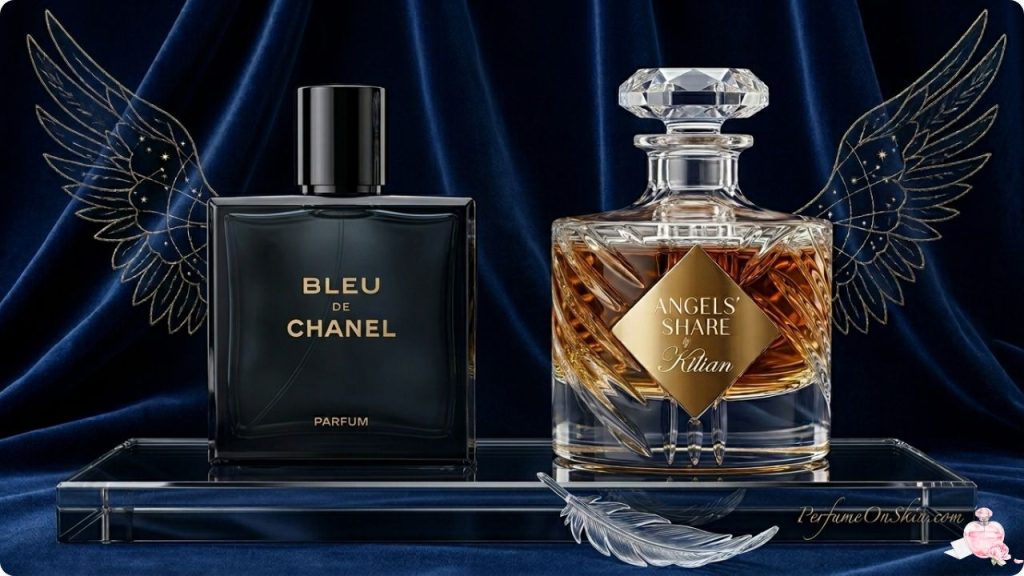
Bleu de Chanel brings a polished citrus-woody structure with aromatic freshness and a clean, versatile profile. Angels’ Share is warmer, sweeter, and denser, with cognac, cinnamon, vanilla, and woods creating a rich amber effect. Put together, they can produce a refined spicy-woody scent with more body than Bleu de Chanel alone and more freshness than Angels’ Share alone. The risk is that the mix can get muddy, overly sweet, or strangely sharp depending on concentration and skin chemistry.
Why bleu de chanel and angels’ share layering works
This pairing works because each fragrance fills a gap in the other. Bleu de Chanel can feel smooth but slightly abstract on some skin types, especially if your skin tends to flatten citrus and emphasize dry woods. Angels’ Share adds texture, warmth, and a more noticeable gourmand edge. It gives the composition a fuller center and a richer trail.
Angels’ Share, on the other hand, can be heavy for daytime or close indoor settings. Its sweetness and boozy warmth may read luxurious, but it can also dominate a room if applied too generously. Bleu de Chanel helps cut through that density with brightness and cleaner aromatic lift. Instead of smelling like a dessert-forward amber, the result can become more tailored and wearable.
The key phrase here is can become. On skin, not every woody-fresh fragrance improves a sweet amber perfume, and not every boozy gourmand gains elegance from a blue fragrance. The overlap has to be managed carefully. Both scents have strong identities. Neither behaves like a neutral base.
Bleu de Chanel and Angels’ Share Layering Guide
| Category | Bleu de Chanel (EDP) | Angels’ Share (Kilian) | Layering Interaction |
|---|---|---|---|
| Fragrance Family | Woody Aromatic | Amber Gourmand | Creates a fresh–warm contrast with aromatic top notes and boozy sweetness. |
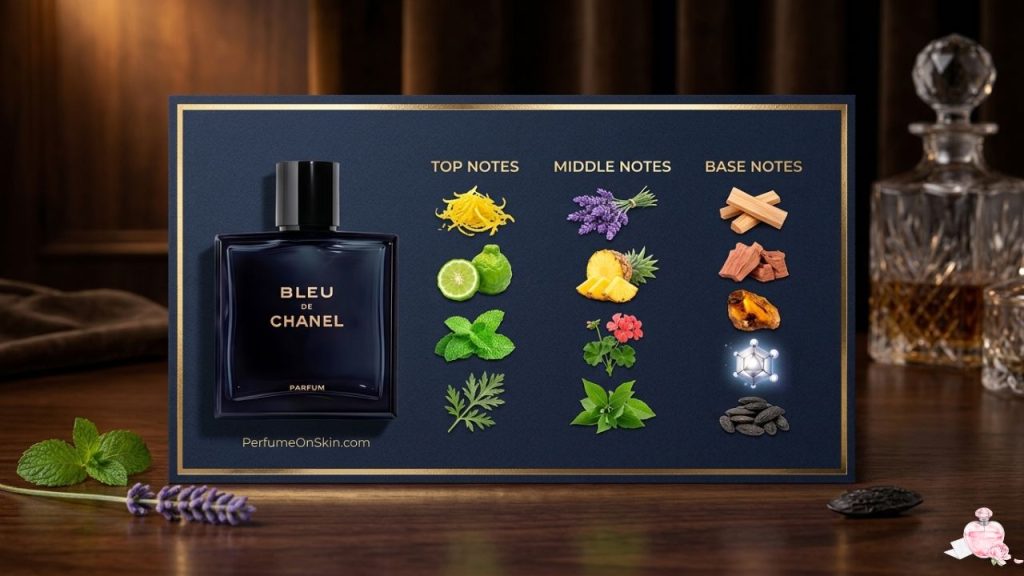
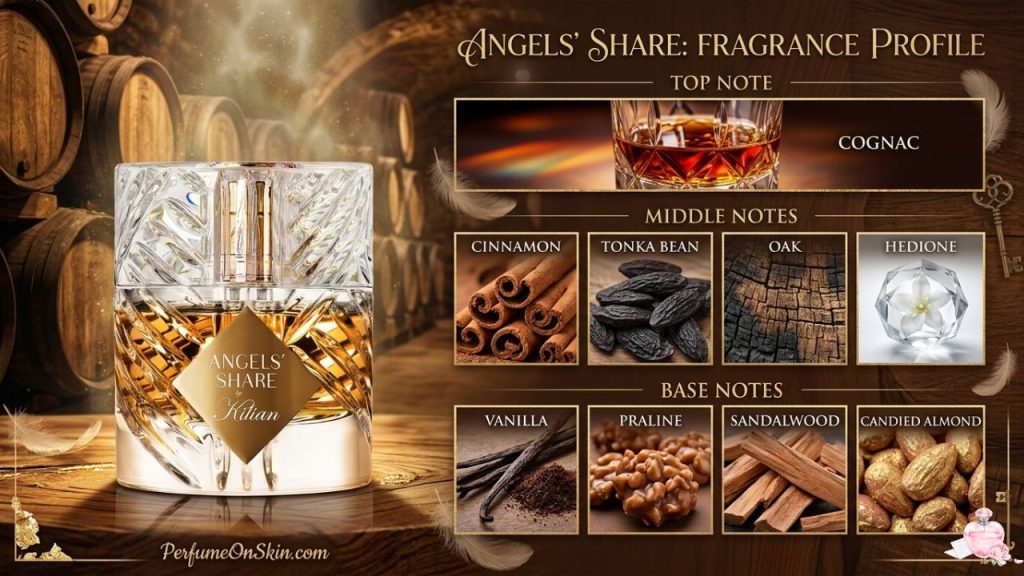
| Key Notes | Lemon Zest, Bergamot, Mint, Artemisia, Lavender, Pineapple, Geranium, Green Notes, Sandalwood, Cedar, Amberwood, Iso E Super, Tonka Bean | Cognac, Cinnamon, Tonka Bean, Oak, Hedione; Vanilla, Praline, Sandalwood and Candied Almond. | Citrus + incense brighten the cinnamon–vanilla warmth, adding structure and lift. |
| Dominant Accord | Fresh citrus–incense woods | Sweet boozy amber | Fresh top layer prevents the gourmand base from becoming too heavy. |
| Projection | Moderate to strong | Strong, dense | Balanced projection: Angels’ Share adds depth; Bleu keeps it wearable. |
| Longevity | 6–8 hours | 10–12 hours | Layering increases overall longevity and adds a richer dry‑down. |
| Best Layering Order |
1. Apply Angels’ Share first (heavier, sweeter base). 2. Spray Bleu de Chanel on top (fresh aromatic lift). |
||
| Season | All‑season | Fall/Winter | Layering works best in cooler evenings or air‑conditioned environments. |
| Occasion | Office, casual, date | Date night, nightlife | Transforms into a sensual, evening‑ready signature scent. |
| Target Vibe | Clean, confident, modern | Warm, seductive, luxurious | Creates a “cool‑meets‑warm” magnetic aura with depth and freshness. |
The scent profile you should expect
In the opening, Bleu de Chanel leads with its burst of lemon zest, bergamot, mint, and aromatic artemisia, creating a crisp, airy freshness. Angels’ Share enters with its signature cognac accord, cinnamon, and tonka bean, adding immediate warmth and sweetness. During the first 20–40 minutes, the blend often feels brighter than expected: Bleu’s citrus‑aromatic lift sits on top while Angels’ Share slowly warms up as body heat amplifies its boozy‑spiced facets.
In the heart, the balance becomes crucial. Bleu de Chanel shifts into its lavender, pineapple, geranium, and green notes, offering a clean, modern aromatic core. Angels’ Share deepens with oak, hedione, and evolving cinnamon‑tonka richness. When the proportions are right, the pairing creates a polished harmony of fresh aromatics, dry woods, cinnamon warmth, and a smooth vanilla‑amber undertone. If overapplied, the contrast can feel disjointed—like a fresh shower‑gel brightness layered over a dessert‑leaning gourmand.
The drydown is where this combination usually shines. Bleu de Chanel settles into its sandalwood, cedar, amberwood, Iso E Super, and tonka bean base, giving structure and lift. Angels’ Share transitions into vanilla, praline, candied almond, and creamy sandalwood, softening Bleu’s sharper edges. On many wearers, this final stage smells more luxurious and more personalized than either fragrance worn alone, creating a warm‑blue signature that feels both modern and indulgent.
Which version of Bleu de Chanel layers best
This matters more than most people expect. Bleu de Chanel Eau de Toilette, Eau de Parfum, and Parfum do not behave the same way in layering.
The Eau de Toilette is the freshest and easiest to overload with Angels’ Share. Its brighter top can create a nice contrast at first, but the lighter body may disappear too quickly, leaving Angels’ Share to take over. If you use the EDT, keep Angels’ Share very light.
The Eau de Parfum is often the safest middle ground. It has enough depth to stand beside Angels’ Share without losing the signature fresh-woody character. For most people, this version gives the best balance of lift, structure, and staying power.
The Parfum version is the smoothest and densest. It can create the most luxurious drydown with Angels’ Share, but it can also become too rich if your skin amplifies sweet or resinous notes. This is the version to choose if you want a darker evening result rather than a versatile all-day one.
How to apply them without creating overload
Start with less than you think you need. That is the most useful rule for this pairing.
Apply Bleu de Chanel first if you want it to act as the frame. One to two sprays on skin is enough for testing. Give it 30 seconds, then add one light spray of Angels’ Share to a nearby area rather than directly on top of the first spray. This lets the fragrances mingle in your scent cloud without becoming a concentrated patch of sweetness.
Apply Angels’ Share first if your goal is to tame it rather than showcase it. In that case, use one spray of Angels’ Share on the chest and one spray of Bleu de Chanel higher on the neck or collar area. The fresher scent rises more noticeably through the air while the sweeter scent stays closer to the body.
For most wearers, the best ratio is 2:1 in favor of Bleu de Chanel. If you reverse that ratio, the result usually stops smelling like a balanced layer and starts smelling like Angels’ Share with a fresh topcoat.
Avoid stacking multiple sprays of both on the same pulse point. Heat will accelerate diffusion and can push the sweet-spicy facets too hard. Separate placement gives you better control over projection.
How skin chemistry changes the result
This is where many layering attempts fail. A pairing that smells smooth on paper can turn uneven once it meets skin.
If your skin runs dry, Bleu de Chanel may fade faster and lose some sparkle. On that skin type, Angels’ Share can quickly become the dominant voice. You may need to moisturize first or use one extra spray of Bleu de Chanel to keep the structure intact.
If your skin amplifies sweetness, cinnamon, or vanilla, use Angels’ Share very sparingly. On sweet-amplifying skin, even one full spray can tilt the blend away from clean sophistication and toward dense gourmand warmth. That is not always bad, but it changes the use case.
If your skin tends to sharpen citrus or aromatic notes, Bleu de Chanel may feel louder than expected in the opening. In that case, wait a minute or two before applying Angels’ Share so the first burst settles. The blend often smells more integrated this way.
At PerfumeOnSkin.com, this is the kind of pairing where testing on your actual wear pattern matters more than first impression. Check it at 15 minutes, 1 hour, and 4 hours. A good layer should improve through wear, not just impress in the opening.
Best occasions for this combination
This is not the most universal layer, but it has a clear lane. It works especially well for evening dinners, cooler weather, date settings, and social events where you want more personality than Bleu de Chanel alone provides.
It can also work in an office if you apply lightly, but only if you keep Angels’ Share under tight control. In close quarters, the warm boozy sweetness can read much louder than you think. For work, one spray of Bleu de Chanel plus a half-spray or very light spray of Angels’ Share is usually enough.
In hot weather, this combination becomes harder to manage. Heat boosts sweetness, spice, and projection, which can make the scent feel thicker and less clean. In cool or cold air, the contrast is better and the structure stays clearer.
Common mistakes to avoid
The first mistake is using normal solo-wear spray counts. If you typically wear four sprays of Bleu de Chanel and three of Angels’ Share separately, do not combine those numbers. Layering compounds projection. Start low.
The second mistake is judging too early. The first 10 minutes can feel disjointed. This pairing often becomes much better after the opening settles.
The third mistake is ignoring fabric. Angels’ Share can cling strongly to clothing, while Bleu de Chanel often behaves more cleanly and transparently there. If you put Angels’ Share on clothes and Bleu de Chanel on skin, the mix may stay sweeter for much longer than intended.
Is this layering combo worth trying?
Yes, if you want a more dimensional, evening-ready version of Bleu de Chanel or a cleaner, more structured version of Angels’ Share. No, if you prefer crisp minimalism, very low sweetness, or easy blind layering. This pairing rewards precision, not excess.
When it works, it smells intentional rather than experimental – warm, polished, and more distinctive than either fragrance worn in the usual way. The smartest approach is to treat it like adjusting seasoning, not building a bigger scent. One small change in ratio can turn a good layer into your best cold-weather signature.
Leave a Comment