
You sprayed your perfume before leaving the house, caught a clear scent trail for the first hour, and now you’re not sure whether it’s faded or you’ve just gone nose-blind. That is usually the real question behind when should you reapply perfume. The right answer is rarely a fixed number of hours. It depends on the fragrance structure, your skin chemistry, the weather, and how much projection you actually want.
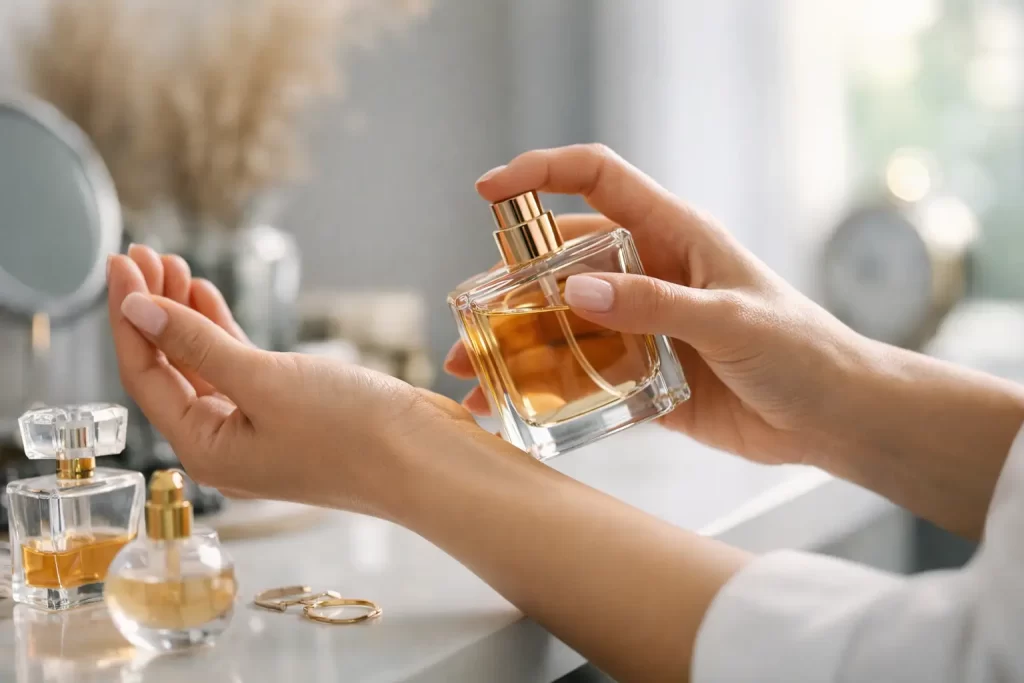
For most people, reapplying is less about chasing all-day intensity and more about restoring the fragrance to the level you intended. A fresh citrus cologne that sits close after three hours may be behaving exactly as designed. A dense amber that still clings to skin at hour eight may not need another spray at all. If you reapply based only on the clock, you will often overdo lighter scents or oversaturate stronger ones.
When should you reapply perfume based on wear time?
As a starting point, many perfumes benefit from a light reapplication somewhere between four and six hours after the first spray. That window works for a lot of eau de parfums and eau de toilettes worn in typical indoor conditions. But it is only a baseline, not a rule.
Lighter fragrance families usually need attention sooner. Citrus, green, aquatic, and many sheer floral perfumes tend to have a bright opening with faster evaporation. On many people, these are the scents that feel noticeably reduced after two to four hours. If your goal is a present, fresh aura through the afternoon, that is often the point where one or two targeted sprays make sense.
Richer fragrance families usually last longer before reapplication is useful. Woods, ambers, gourmands, resins, leather, patchouli-heavy blends, and musks can remain on skin for six to ten hours or more, even when the top notes have disappeared. In those cases, what has changed is not necessarily longevity but shape. The scent has moved into its drydown. Reapplying too early can stack the sparkling top on top of an already strong base and create a heavier effect than the perfumer intended.
Concentration matters too, but not as much as many people assume. An eau de parfum often lasts longer than an eau de toilette, but composition can matter more than the label. Some airy eau de parfums disappear faster than resinous eau de toilettes. If you want a reliable reapplication schedule, test your own bottle on your own skin rather than relying on concentration alone.
The better cue is performance, not the clock
The most useful way to decide when should you reapply perfume is to watch for a drop in performance across three areas: skin scent, projection, and character.
Skin scent tells you whether the fragrance is still physically present. Put your nose close to the spot where you sprayed. If you can still smell it clearly on skin, the perfume has not vanished. It may simply have stopped projecting. That distinction matters because not everyone wants strong projection all day.
Projection tells you how far the scent radiates. If you usually catch your fragrance in the air when you move and now you only smell it with your nose against your wrist, the perfume has shifted from projecting to sitting close. That is often the ideal point for reapplication if you want others to notice it at conversational distance.
Character is the overlooked metric. Sometimes a fragrance is technically still there, but the facets you enjoy are gone. Maybe the bright neroli has burned off and only dry musk remains, or the juicy fruit opening is gone and the base feels flat on your skin. If the perfume no longer smells like the version you chose to wear, reapplying can restore balance.
Skin chemistry changes the answer
On PerfumeOnSkin, one of the core principles is that fragrance performance is personal. The same perfume can last three hours on one person and eight on another. Skin chemistry is a major reason why.
Dry skin usually holds perfume less effectively than moisturized skin. If fragrance seems to disappear quickly on you, the issue may not be weak perfume but insufficient oil on the skin surface to slow evaporation. In that case, you may think you need to reapply constantly when a better fix is to moisturize first and spray over hydrated skin.
Oily skin often extends wear, especially with richer formulas. Body heat also changes the equation. Warmer skin can boost projection early, but it can also push top notes off faster. If you naturally run warm, a perfume may smell vivid in the first hour and then feel like it drops off sharply. That does not always mean the fragrance is gone. It may have moved through its opening faster than expected.
Skin pH gets mentioned often in fragrance discussions, but in practical wear, moisture level, oil production, and heat usually have the bigger day-to-day effect. That is why two reapplication strategies that seem identical on paper can perform very differently in real life.
Situations where reapplying earlier makes sense
There are times when a shorter reapplication interval is reasonable, even with a well-performing fragrance.
If you are outdoors in heat, wind, or dry air, expect faster evaporation and weaker persistence in the air around you. Air-conditioned offices can also dull your perception of scent and dry out skin. Long commutes, travel days, and event days often justify carrying a travel spray because your environment is working against longevity.
Another factor is application style. If you used only one or two sprays in the morning because you wanted restraint for work, a small afternoon refresh may be smarter than applying six sprays upfront. Reapplication is often the better way to control scent level across different parts of the day.
Then there is the purpose of the fragrance. If you wear perfume mainly for your own enjoyment, you may be happy once it becomes a soft skin scent. If you want a fragrance to stay noticeable in social settings, dinners, or evening events, you will usually reapply earlier.
How to reapply without overspraying
Reapplication should be lighter than your original application in most cases. If you started with four sprays in the morning, you probably do not need another four in the afternoon. One or two sprays is often enough to lift the fragrance back into projection.
Placement matters. Reapplying to the exact same heavily scented area can create buildup, especially with sweet or woody perfumes. A better approach is to refresh one pulse point and, if needed, one non-pulse area such as the chest or back of the neck. This gives the scent room to bloom again without becoming dense.
Hair and clothing can extend wear, but use caution. Fabric can hold scent longer than skin, which sounds helpful until the fragrance becomes stale, overly loud, or out of sync with the fresh spray on your skin. Some formulas can also stain delicate fabrics. If you reapply on clothing, use less than you think you need.
Signs you should wait instead of reapplying
One of the most common mistakes is reapplying because you personally stop noticing the fragrance. Olfactory fatigue is real. Your nose adapts to familiar smells quickly, especially musks, ambers, and woody molecules. Before adding more, ask whether other people can still smell it or test a different area of skin that was not directly under your nose all day.
You should also wait if the base notes are still strong. A perfume that has lost its opening can still be very present to others. This is especially true with fragrances built around vanilla, amberwood, patchouli, oud-style accords, white musk, or tonka. Reapplying on top of a still-active base can turn elegant into exhausting.
If you are moving from a close-contact setting to another close-contact setting, restraint matters. Elevators, shared offices, rideshares, and restaurants all reduce your margin for error.
A practical rule by fragrance type
If you want a simple working rule, reapply citrus, aquatic, green, and sheer floral perfumes after two to four hours if you want continued freshness. Reapply balanced eau de toilettes and many mainstream eau de parfums after four to six hours if projection has clearly dropped. Reapply dense woods, gourmands, ambers, and musks only after six or more hours, and only if the scent is genuinely fading rather than just settling.
That framework works better than a one-size-fits-all schedule because it accounts for how fragrance families typically behave on skin. Still, your own wear test should be the final standard. Spray the same amount in the same spots for several days, check performance at set intervals, and notice when the scent shifts from projecting to close-to-skin to barely detectable. That gives you a reapplication window based on evidence, not guesswork.
The smartest way to wear perfume is not to force every scent into all-day performance. Some fragrances are meant to feel airy and brief, others are built to linger. Reapply when the perfume no longer matches the effect you wanted, not just when the hours add up.



Leave a Comment