
If you have ever loved a fragrance in store and then felt underwhelmed by it at home, the format may be part of the problem. Perfume oil vs spray is not just a packaging preference. It changes how a scent projects, how long it lasts, how it develops on skin, and how much control you have over the wearing experience.
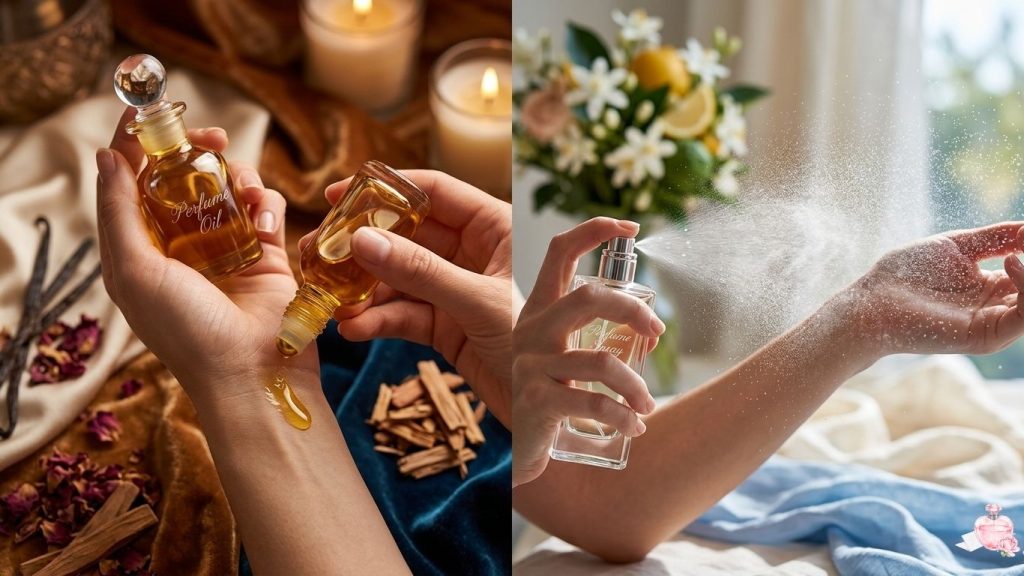
For most people, the right choice comes down to one practical question: do you want your fragrance to stay closer to the skin, or do you want it to announce itself more clearly? Both formats can smell beautiful, but they behave differently enough that choosing the wrong one for your habits, skin type, or setting can lead to disappointment.
Perfume oil vs spray: the core difference
The biggest difference is the carrier. Perfume sprays are typically diluted in alcohol, while perfume oils use an oil base. That one change affects evaporation rate, projection, and the way the fragrance unfolds over time.
Alcohol evaporates quickly, which helps launch a fragrance into the air. That is why sprays usually feel brighter and more noticeable right after application. You get more lift from top notes like citrus, herbs, and fresh aromatics. If you care about sillage and first impression, spray usually has the advantage.
Oil sits closer to the skin and evaporates more slowly. That often creates a softer, more intimate scent cloud. Instead of broadcasting outward, the fragrance tends to warm up gradually and remain detectable near the application point. If you prefer subtle wear or find many perfumes too sharp at first, oil can feel smoother and easier to live with.
How they differ on skin
Skin chemistry matters in both formats, but it often shows up differently.
On dry skin, perfume oil can have a clear performance edge because it adds emollience while carrying the fragrance. Since dry skin tends to “drink up” scent faster, an oil base may help slow that process. A spray on very dry skin can disappear faster, especially if it relies on delicate top notes and lighter musks.
On balanced or slightly oily skin, either format can perform well, but the experience will still differ. Spray usually opens more dramatically and may project farther for the first few hours. Oil may last a long time, but with less noticeable diffusion unless someone is close.
Body temperature also plays a role. Warmer skin pushes fragrance outward faster, which can make sprays feel more vibrant but shorter-lived in the opening. Oils on warm skin tend to bloom steadily. That can be especially useful with richer notes like amber, vanilla, woods, and resin, which often feel more rounded in oil format.
Longevity is not the same as projection
This is where many buyers get tripped up. They assume the format that lasts longer is automatically better. In practice, longevity and projection are separate performance traits.
Perfume oil often wins on close-to-skin longevity. You may still smell it on your wrist after a full workday, especially if the formula leans warm, musky, or gourmand. But that does not mean others can smell it from several feet away. Much of that wear time can be intimate rather than room-filling.
Spray often wins on projection, especially in the first one to three hours. That initial burst creates the trail many people associate with “good performance.” But because alcohol disperses quickly, the scent may feel less present to you later, even if traces remain on skin or clothing.
So if your goal is compliments across a room, spray is usually the safer choice. If your goal is personal enjoyment and a scent that stays with you without dominating the space, oil may be the better fit.
Which format smells stronger?
Stronger can mean different things. Spray usually smells stronger in the air. Oil often smells stronger right at the skin.
That distinction matters when you test. A spray can impress immediately because the top notes expand fast and create a clear scent bubble. Oil may seem quieter at first, then become richer and more cohesive after several minutes of warming on skin.
This is why some people describe oils as deeper or denser even when they are less noticeable from a distance. The scent is concentrated in a smaller radius. You experience more of the heart and base, and less of the sparkling lift that alcohol gives to the opening.
When spray is the better choice
Spray tends to be more versatile for people who want traditional perfume behavior. It is usually the better fit for daytime wear in social settings, events, offices where one or two controlled sprays are acceptable, and situations where you want noticeable presence.
It is also better if you care about experiencing the full structure of a composition. Top notes generally perform more clearly in spray form. If you love neroli, bergamot, green notes, aldehydes, or airy florals, a spray is more likely to show those details as intended.
Application is faster and often more even. You can mist pulse points, clothing, or hair with relative ease, though fabric testing is still smart. For many people, that convenience matters more than the subtle performance benefits of oil.
When perfume oil is the better choice
Oil is often the smarter option for fragrance-sensitive environments or for wearers who want precision. It gives you more control over placement, usually causes less airborne diffusion, and often feels less aggressive in the opening.
That makes oil especially useful for travel, evening wear, close-contact situations, and anyone who finds alcohol sprays too sharp or drying. It can also be excellent for layering. Because oils stay close to the skin, they can create a scented base underneath a spray without turning the final result chaotic.
For people focused on skin chemistry, oils are worth serious consideration. At PerfumeOnSkin, this is one of the most practical format decisions because the same scent family can behave very differently depending on your skin’s moisture level and how much projection you actually want.
The trade-offs most shoppers miss
Neither format is automatically superior. Each asks you to accept a trade-off.
Spray gives you lift, diffusion, and a more legible opening, but it may feel shorter-lived on dry skin and can be easier to overapply. Oil gives you smoothness, intimacy, and often better close-wear persistence, but it may not satisfy if you want obvious sillage.
There is also the question of consistency. Sprays can feel more uniform from wear to wear because atomization spreads the fragrance across a larger area. Oils are more placement-specific. A small amount on warm pulse points may behave differently from the same amount on cooler skin.
And then there is seasonality. In hot weather, sprays can feel fresher and more breathable, while heavy oils may become dense if overapplied. In cooler weather, oils often shine because they hold onto richer notes well and avoid the sharpness some alcohol-based scents can show in dry air.
How to choose based on your goal
If you are deciding between perfume oil vs spray, start with use case rather than concentration claims or marketing language.
Choose spray if you want projection, a brighter opening, easier all-over application, or a fragrance that reads clearly to others. It is usually the more familiar and flexible format for daily rotation.
Choose oil if you want a skin scent effect, longer close-wear, less alcohol bite, or better control in scent-restricted environments. It is often the more personal format and can be especially rewarding for warmer, sweeter, and woodier profiles.
If you own both, use them strategically. Oil can anchor a scent on skin, while spray adds lift and air. That pairing often gives a more balanced result than relying on either format alone.
Application changes the outcome
Even the best format can disappoint if applied poorly.
With spray, distance matters. Spraying too close can oversaturate one spot and flatten the development. A few controlled sprays across pulse points or upper torso usually performs better than aggressively layering the same area. Moisturized skin also improves retention.
With oil, restraint matters. Because it sits close and develops slowly, overapplication can create heaviness rather than better performance. Apply a small amount first, then reassess after 15 to 20 minutes. Oils often reveal their true character after they warm up.
Avoid rubbing either format aggressively into the skin. The old habit of rubbing wrists together does not help performance and can disturb the opening, especially with sprays.
The better question is not which is best
The better question is which format matches your expectations. If you expect an oil to project like a spray, it will seem weak. If you expect a spray to cling like an oil on very dry skin, it may seem fleeting.
Fragrance works best when the format supports the way you wear it. A quiet office, dry skin, and a preference for intimate scent usually point toward oil. Social settings, fresh fragrance families, and a desire for noticeable sillage usually point toward spray. Many fragrance lovers end up wanting both because they solve different problems.
If you are trying to get better performance from the perfumes you already own, pay attention to how the format interacts with your skin, not just how it smelled on paper or on someone else. The best choice is the one that behaves the way you need it to once it is actually on you.



Leave a Comment