
You spray a perfume, love the opening, and then 45 minutes later it smells flatter, sweeter, woodier, or simply less like what sold you in the first place. That shift is exactly why a guide to perfume dry down matters. If you only judge a fragrance in its first few minutes, you are evaluating the least stable part of the wear.
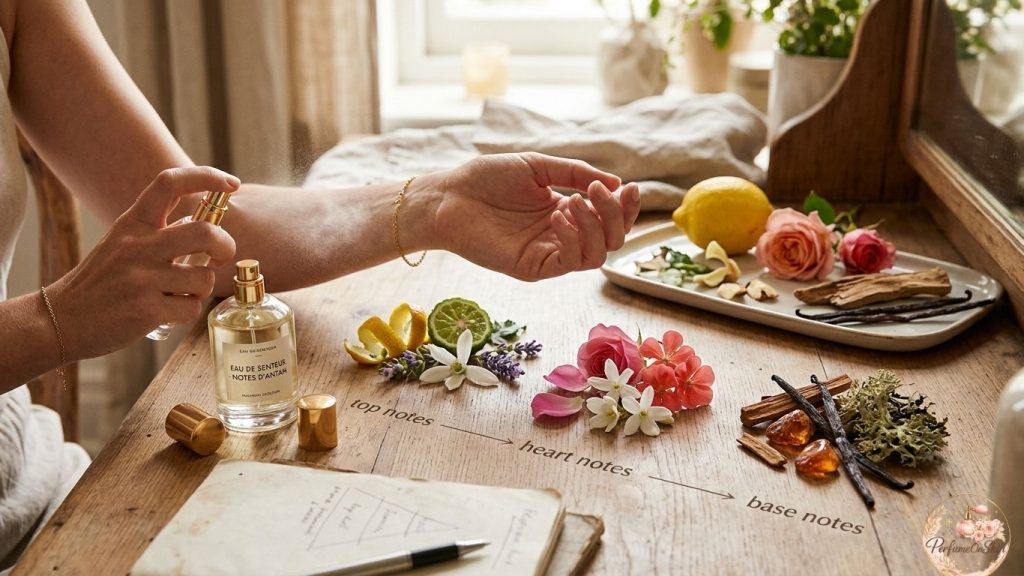
Dry down is the stage when the most volatile top notes have mostly lifted and the fragrance settles into its heart and base. This is the version of the perfume that stays closest to your skin for hours, and in many cases it is the scent other people will notice most once the opening has passed. For practical fragrance buying, the dry down often matters more than the first impression.
What perfume dry down actually means
A perfume does not smell the same from first spray to final fade because its ingredients evaporate at different speeds. Citrus, aldehydes, and airy aromatics tend to appear first and leave fastest. Florals, fruits, spices, and greens often shape the middle phase. Woods, musks, resins, amber materials, vanilla, and balsamic notes usually anchor the dry down.
That does not mean every fragrance unfolds in clean layers. Some modern formulas are intentionally linear and stay fairly consistent. Others change dramatically. A fresh perfume may dry down creamy. A smoky fragrance may end up soft and skin-like. A sweet gourmand may lose its dessert effect and become mostly musk and sandalwood after an hour.
This is where many shoppers get tripped up. Counter testing rewards the opening because that is what you smell immediately. Living with a fragrance rewards patience because the dry down tells you what you are actually committing to.
Why the dry down matters more than the opening
The opening is marketing-friendly. It is bright, attention-grabbing, and easy to like in a quick test. The dry down is performance reality. It affects whether a perfume feels sophisticated or heavy, clean or powdery, cozy or sharp after the excitement of the first spray disappears.
If you are deciding whether to buy a bottle, the dry down answers better questions than the top notes do. Will this scent still suit me after two hours? Does it become too sweet on my skin? Does the floral heart vanish and leave only musk? Does it sit close to the skin in a way I enjoy, or does it turn dense and cloying in warm weather?
For anyone focused on value, this matters even more. A perfume you love for five minutes but dislike for six hours is not a good purchase. The reverse can also happen. Some fragrances open harsh or synthetic and then smooth out beautifully once they settle.
Guide to perfume dry down on skin
Skin chemistry changes how dry down behaves, but not in a magical or unpredictable way. Skin type, temperature, oil level, hydration, and even how much you spray all influence how materials develop.
On oilier skin, fragrance often projects more and can hold richer base notes longer. On dry skin, the same perfume may feel thinner, quieter, or fade faster, which can make the dry down seem less rounded. Warm skin tends to push a scent outward and speed up development. Cooler skin may keep a perfume closer and slower.
Application also matters. Perfume on moisturized skin usually transitions more evenly than perfume on very dry skin. If you spray immediately after a hot shower, heat can amplify the opening and alter how quickly the fragrance moves into the dry down. Fabric can preserve some notes differently than skin, which is why a sleeve may still smell citrusy while your wrist has already turned woody and musky.
This is one reason fragrance recommendations can feel inconsistent. Two people may wear the same perfume but experience different balances in the base. One person gets creamy vanilla and cashmere musk. Another gets mostly cedar and pepper.
How long perfume dry down takes
There is no single clock, but most perfumes begin reaching a recognizable dry down somewhere between 30 minutes and 2 hours after application. Lighter eau de toilettes can settle faster. Dense extraits, resinous ambers, and heavy gourmands may keep evolving for longer.
The useful takeaway is simple: do not judge a perfume at the 3-minute mark. If you are testing for purchase, give it at least an hour on skin, and ideally longer. The best read on a fragrance usually comes after the opening glow has faded and the scent has stopped changing so quickly.
If a perfume is very strong, the dry down may still project noticeably. If it is lighter or more transparent, the dry down may become a skin scent. That is not automatically poor performance. For some wearers, a close, polished dry down is the goal.
How to test dry down before buying
If you want a repeatable method, test one fragrance per arm and keep your skin product-free or use the same unscented moisturizer each time. Spray from a normal wearing distance and use a consistent number of sprays. Then smell at three checkpoints: first 5 minutes, around 45 minutes, and around 2 to 4 hours.
At the first checkpoint, note what draws you in. At the second, pay attention to what has disappeared and what has become dominant. At the last, ask whether the remaining scent is something you still want around you. This simple structure gives you a better buying signal than repeatedly smelling the nozzle or paper blotter.
Blotters still have a role. They help you screen many scents quickly and reduce nose fatigue. But they are poor stand-ins for skin when your main concern is dry down. Paper does not have body heat, skin oils, or your personal scent profile, so the base can read cleaner or more static there.
A good rule is to use blotters for elimination and skin for decision-making.
What common dry down patterns tell you
Certain shifts show up often enough to be useful when you are learning how to evaluate perfume.
If a fragrance turns sweeter over time, that usually means vanilla, tonka, amber, or musky materials are coming forward as fresher notes burn off. If it becomes powdery, iris, heliotrope, violet materials, or soft musks may be taking over. If it gets woodier and quieter, sandalwood, cedar, vetiver, patchouli, or ambers may be forming the base impression.
Sometimes the dry down feels flatter than the opening. That does not always mean the perfume is low quality. It may simply be built around a minimal base or designed for a clean-skin effect. The key is whether the final stage matches what you want. A subtle musk is excellent for close-wear settings and less useful if you expect strong evening projection.
The opposite problem is a dry down that becomes muddy or overly dense. This can happen when sweet, woody, and musky base materials pile up on warm skin or in humid weather. If that happens consistently, the issue may be fit rather than composition. The perfume is not wrong. It is wrong for your skin, climate, or use case.
How to improve a perfume’s dry down
You cannot completely rewrite a fragrance, but you can influence how clearly and comfortably it settles. Moisturized skin usually gives base notes a smoother landing. Applying to pulse points plus one lower-heat area, like the chest, can create a more balanced evolution than spraying only the neck. Using fewer sprays can also help if a scent gets heavy in the base.
Layering can make a difference, but it should be strategic. If a perfume dries down too sharp, pairing it with an unscented moisturizer or a soft musk body product may round it out. If it dries down too sweet, adding more fragrance is rarely the answer. Reducing spray count is often more effective than layering another rich product on top.
Temperature matters too. A perfume that dries down beautifully in cool weather may feel thick in summer. Test again in a different season before deciding a fragrance no longer works for you.
When dry down should change your buying decision
If the dry down loses the character you wanted, that is a real reason to walk away. This is especially common with perfumes bought for a specific note. If you want rose and the rose is gone in 20 minutes, what remains has to be good enough on its own. If you want a fresh citrus for daytime and it dries down into sugary amber, the fragrance is not meeting the brief.
On the other hand, do not reject a fragrance just because the opening is underwhelming. Some of the best wearers improve with time. On PerfumeOnSkin, the practical standard is simple: buy for the stage you will live in, not the stage that grabs you first.
A useful final test is to ask yourself one plain question a few hours in: would I enjoy smelling like this for the rest of the day? If the answer is yes, the dry down is doing its job. If not, keep sampling. Your perfect scent is much more likely to reveal itself after the first impression fades.





Leave a Comment