
Most perfume mistakes happen in the first five minutes. You smell a fragrance on a paper strip, get a bright top note, buy the bottle, and then wonder why it turns flat, sharp, or overly sweet once it hits your skin. If you want to know how to test perfume on skin properly, you need a method that shows how the scent develops on you, not just how it opens in the air.
Testing perfume well is less about having an advanced nose and more about controlling variables. Skin chemistry, application amount, environment, and even what you wore earlier that day can change your read on a fragrance. A proper skin test helps you judge four things that matter in real life: the opening, the dry down, longevity, and projection.
Why testing on skin matters more than testing on paper
A blotter is useful, but it only tells part of the story. Paper can help you screen several options quickly because it gives you a cleaner read on the composition without interference from body heat, oil levels, or moisturizer. That makes it a good first filter.
But perfume is worn on skin, not on cardstock. Once fragrance meets your skin, warmth increases evaporation, oils can soften or amplify certain notes, and your natural scent profile changes how the formula reads. A woody perfume that feels smooth on one person can smell dry and peppery on another. A sweet floral can become creamy, powdery, or louder than expected depending on your skin and the weather.
If your goal is choosing a fragrance you will actually enjoy wearing, paper is only step one. Skin testing is where the real decision happens.
How to test perfume on skin properly before you buy
Start with clean, unscented skin. If you already have body spray, scented lotion, or another fragrance on your arms or wrists, your test is compromised before it begins. Even residue from a heavily fragranced soap can skew the opening.
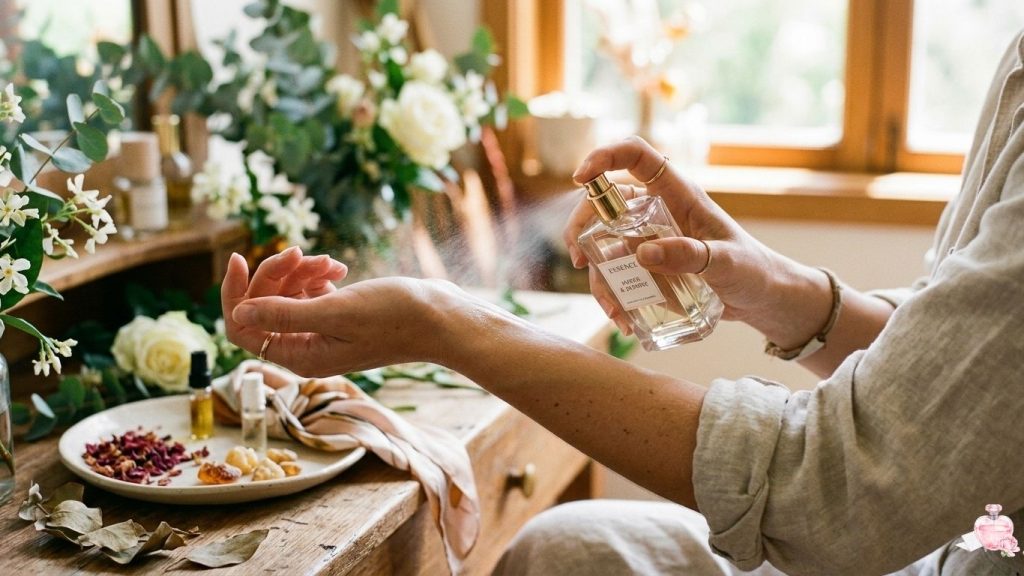
Apply perfume to pulse points or nearby skin with enough surface area to observe development. The inner wrist and inner elbow are the most practical testing spots. If you are trying two fragrances, use one on each arm and keep them separated. Testing more than two on skin at once usually creates confusion, especially for newer fragrance users.
Use one to two sprays per fragrance. Too little and you may underread the perfume’s projection and evolution. Too much and the opening can feel harsher or denser than normal. If you are in a store and the atomizer is unusually forceful, one spray is often enough.
Then leave it alone. This is the step people get wrong most often.
Do not rub your wrists together. Rubbing does not destroy perfume in a dramatic way, but it does change the evaporation pattern and can flatten the opening before you get a clean read. You want the fragrance to settle naturally.
Give the scent time to move through stages. Smell it at the 1-minute mark for the opening, around 15 to 20 minutes for the transition, and again at 45 to 60 minutes for the early dry down. If you are seriously considering a purchase, keep checking at the 3-hour and 6-hour marks. That timeline tells you much more than the first impression ever will.
What to pay attention to during a skin test
A proper test is not just asking, “Do I like this?” It is asking a series of more useful questions.
First, notice whether the opening is appealing enough to wear. Some perfumes start sharp and settle beautifully. Others open beautifully and become dull within half an hour. If the first few minutes are unpleasant but the dry down is excellent, that may still be worth it depending on how and when you plan to wear it. But if you dislike both the opening and the mid-stage, there is no reason to force a purchase.
Next, pay attention to the transition. This is where skin chemistry becomes obvious. Citrus may disappear quickly on dry skin. Vanilla can swell and become heavier on warmer skin. White florals may turn creamier or more indolic depending on the formula and your body heat. This transition phase often determines whether a fragrance feels refined or mismatched.
Then assess the dry down. This is the version of the perfume you will live with for hours. If you only judge the top notes, you are making a buying decision based on the shortest part of the wear.
Finally, check performance. Ask how long the scent remains detectable on skin and how far it projects. A fragrance can smell wonderful up close but disappear in an hour. Another can last all day but sit very close to the skin. Neither is automatically better. It depends on whether you want office-friendly subtlety, stronger evening presence, or something in between.
Common testing mistakes that lead to bad fragrance buys
The biggest mistake is testing too many perfumes at once. Once your nose is overloaded, everything starts to blur into sweet, musky, or vaguely floral impressions. If you are shopping in person, use blotters to narrow your options to two or three, then place only one or two on skin.
The second mistake is deciding too quickly. A lot of fragrances are built to impress in the first ten minutes. That does not mean they wear well for the next six hours. Quick judgments favor bright openings and penalize scents with slower, more nuanced development.
Another issue is testing under the wrong conditions. Heat, sweat, dry winter skin, and recently applied lotion all affect performance. This does not mean you need lab conditions, but it does mean you should interpret the result in context. If a scent feels weak on very dry skin in cold weather, it may perform better after moisturizing or in a warmer season.
There is also the problem of testing right after smelling strong environmental odors. Coffee beans are often offered at fragrance counters, but they are not a reset button. Fresh air and a short break usually work better than pushing your nose through a dozen intense aromas.
How to compare perfumes fairly on skin
If you are choosing between two fragrances, test them in the same session and in similar amounts. Put one on the left inner wrist or arm and one on the right. Avoid stacking multiple fragrances on the same area because overlap makes performance hard to judge.
Write down the time of application and your quick impressions at each stage. This sounds excessive until you test three fragrances in one week and realize you can no longer remember which one had the better dry down. A simple note in your phone is enough: opening, 20 minutes, 1 hour, 4 hours, and whether you still detect it by the end of the day.
Try to compare them in the kind of environment where you will actually wear them. A skin test in an air-conditioned store is useful, but it is not the same as wearing a scent on your commute, at work, or at dinner. If possible, ask for a sample and do a full-day wear test before buying a full bottle.
When skin chemistry changes the result
Skin chemistry is real, but it is often oversimplified. It does not mean your skin magically transforms every perfume beyond recognition. What usually changes is emphasis. Your skin may pull sweetness forward, mute fresh notes quickly, or make amber and musk last longer than expected.
Oil level matters too. Oily skin often holds fragrance longer, while very dry skin may make top notes vanish faster. Moisturized skin usually gives a more stable test result than dry, flaky skin, but use an unscented moisturizer if you do this. A strongly fragranced body cream turns a perfume test into layering, which is a different experiment.
Hormonal shifts, climate, and even stress can influence how a fragrance feels from day to day. That is why a single five-minute test is rarely enough for an expensive purchase.
How to know when a perfume passed the test
A successful skin test is not just a fragrance that smells good once. It is a fragrance that stays enjoyable as it develops, fits your preferred strength level, and performs in a way that matches your lifestyle.
If you love the dry down, enjoy the projection, and still want to smell it after several hours, that is a strong sign. If you keep checking your wrist because the scent is interesting in a good way, pay attention to that. If you find yourself wishing it would fade, that is useful information too.
At PerfumeOnSkin.com, the best fragrance decisions come from repeatable testing, not impulse impressions. A good perfume should earn its place on your skin over time.
The smartest way to shop is simple: test fewer scents, give each one more time, and trust the version that shows up after the excitement of the opening is gone.



Leave a Comment